Hello Ganoksin community,
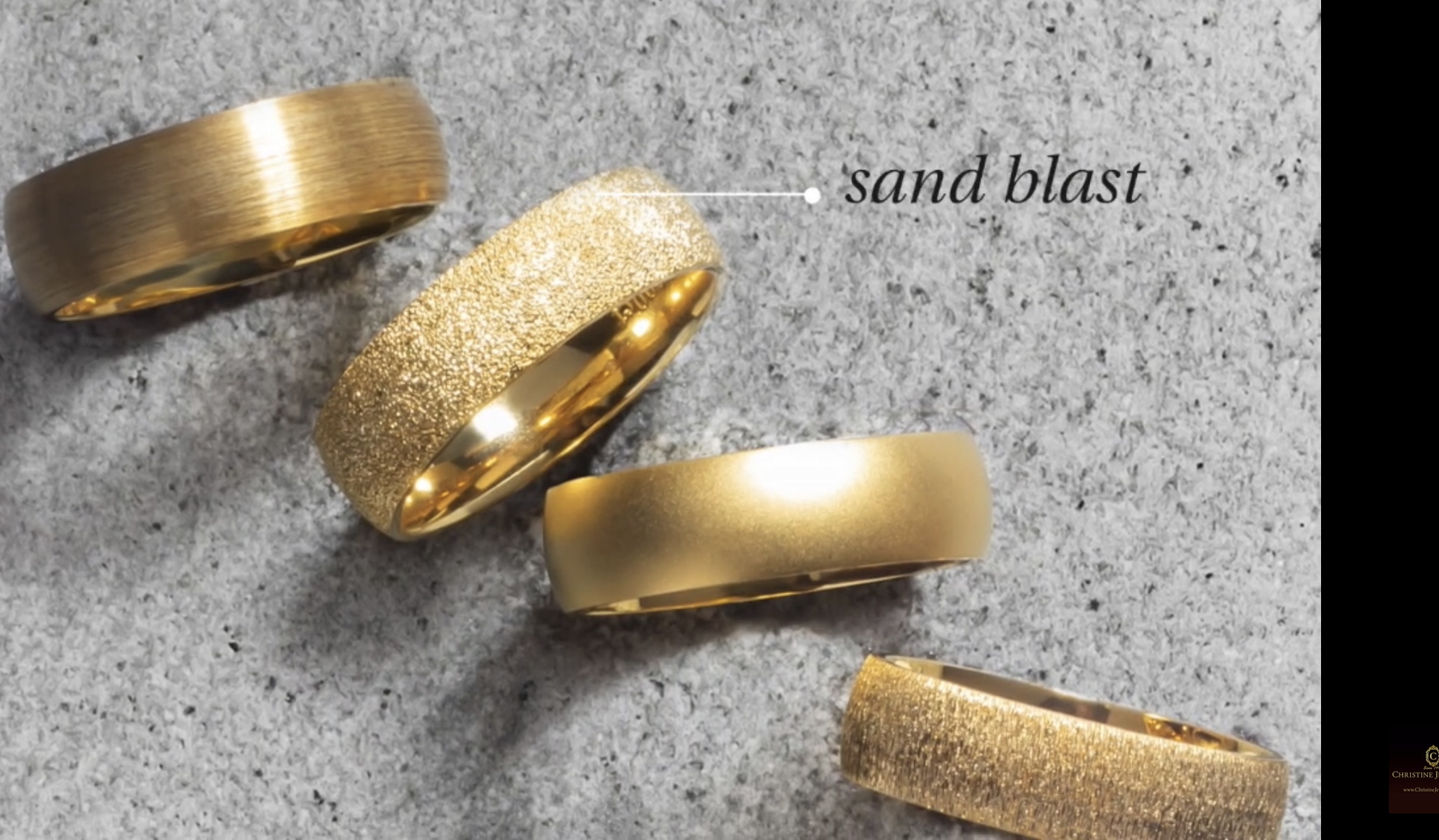
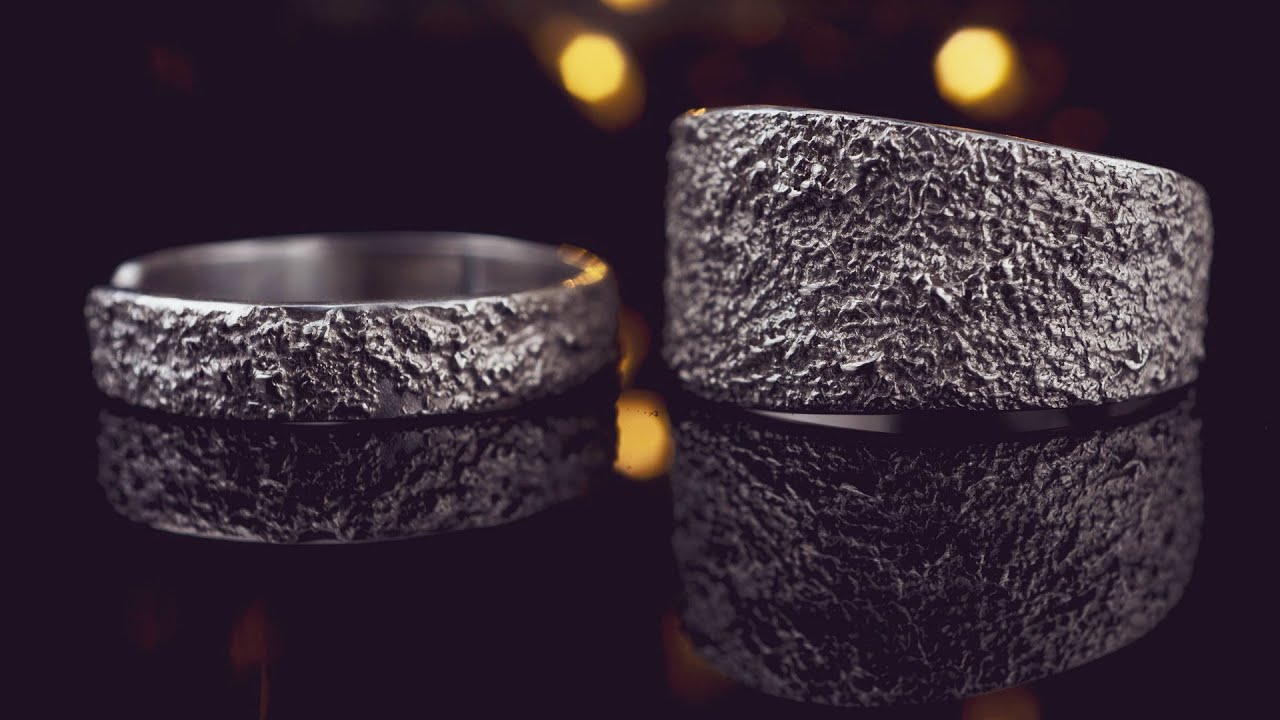
I am wondering if anyone has suggestions on how to get this type of sandblast texture? I have purchased the wire wheels and I do also have a sandblast cabinet but my attempts with both are making the texture look more-so matte or satin rather than bumpy and textured.
I’m wondering which type of medium I should use or if I should try a different tool?
The appearance of that texture on that ring looks to me like the media is pretty large and very aggressive. It probably has a pretty powerful compressor behind it. That said my experience with sandblast finishes was on steel boat hulls about 45 years ago. I have a neighbor who rebuilds race car engines and uses a sand blaster. I’ll see if I can replicate what you have in the photo if he will allow me back in his shop. (We disagree some significantly over politics.) I have needed to try soda blasting and this may give me the chance.
To me it looks like something made out of fused “beads”/powders.
The one on the left looks “ground”, coarse sandpaper maybe, the one on the right might be blasted, glass, nutshell or other media.
That is what I can get out of the actual picture.
Maybe rolling it against a coarse sandpaper may get a similar but sharper texture?
Do people really run sand paper through their rolling mills? I realize that the plan is for the grit to be in contact with the material being textured, not the rollers, but what if some grit gets loose and gets run between the rollers? I would want to see some real protection from this possibility before it was run through my mill. My guess is that the heavy textures are some form of deposition…Rob
I can’t see that as an option since it has to be on the outside of the ring.
But generally speaking it seems as a risky affair to me.
I would not do it.
Better with a hydralic press or something like that.
When that is said.
It would be an interesting texture with the sharp crystalline shapes from the crystals from a coarse sandpaper onto a ring.
How durable it would be, is another question indeed.
Yes, you’re right it does seem like some type of fusion in a way because of the depth, or a very deep and coarse sandblasting. I will keep testing different media.
Don, thank you so much for trying. I don’t want you to have a problem with your neighbor, but if he lets you give it go let us know! Haha
Yes, unfortunately the rolling mill wouldn’t work for me because I just need it on the outside of a casted ring.
Yes, that’s very true the stippling tool is also a good idea to try. And the lathe as well, I will keep testing options and let everyone know thank you for your help
A-yup. 3M has some papers where the grit is very well bonded, as opposed to cheap sandpaper where the grit can be brushed off with your fingers.
My only problem with the above link is that it shows the sheets flat, and mine curve almost into a tube, which can be annoying. Maybe they have corrected that. Skipping the curling, they are good papers.
I sandwich the paper and metal between roller-wide sheets of 90 lb. card stock to be sure no grit touches the rollers. After rolling I do look for grit. Have never seen any. This works well for flat sheet metal, not for a ring with a domed shank.
One might be able to press very coarse sandpaper into a ring like that using a hydraulic press and urethane, rotating the ring and sandpaper. It would be worth a try if the tools were on hand.
Neil…I would be comfortable with the safety of what you describe. My comment was intended more for someone new to what we do thinking that there was no peril in slapping a piece of cheap hardware store sandpaper, steel wool or some other sort of abrasive material on a piece of metal and running it through their brand new rolling mill. Thanks…Rob
But I did try it with a stippling bit in my Foredom Hammer. I messed with it a little on a piece of copper. I can replicate your surface in the photo, sort of.
I polished the copper and then dithered it some considerably. It gets a similar look. But I worry it also gives a very temporary finish. If it was ever polished again I think you’d lose much of the surface you wanted.
edit: As I looked at the photo a bit more it almost seems like the surface is “Plated” or applied after the the ring is formed. The photo from Julie using silver dust looks pretty neat.
That particular surface is achieved by using a flex shaft hammer hand piece with either an old broken off highly polished sharp tipped burr or a “pavetron” which is a bur with the culet of a diamond facing out on the tip. We use both depending on the reflectivity you want.
-Jo