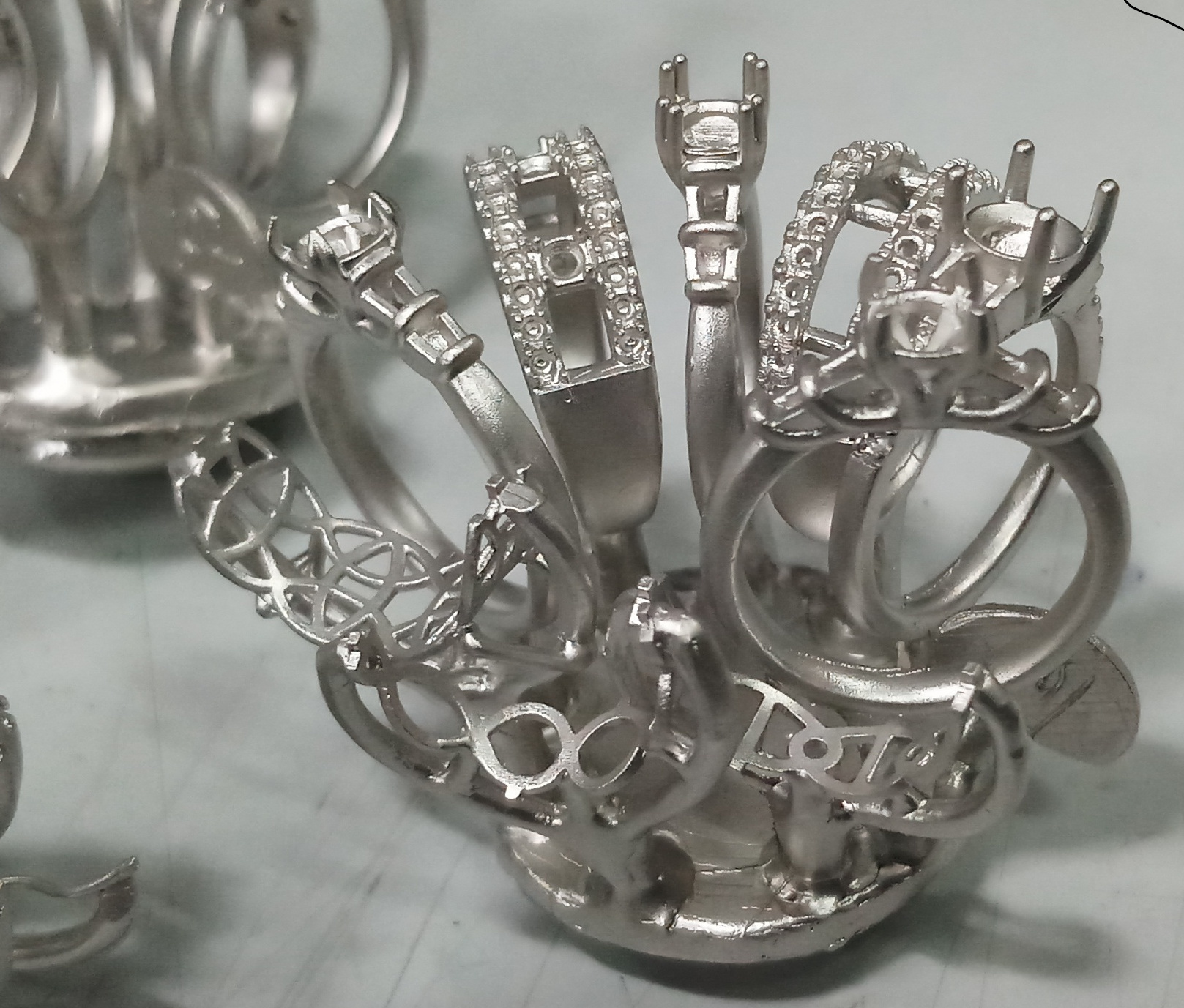
Theory be damned, do YOU make sure that all stones are supper
clean before heating. One speck of dirt etc. behind any stone can
sure ruin my day.
Yes, caked dirt can be a real problem. I make sure that pavilions
are open and freely accessible, so few minutes in ultrasonic
eliminates this possibility.
But can I cast in it when all I know how to cast is sterling? I get
nervous when my caster tells me it usually takes them a couple of
times to cast Pt right....so how am I supposed to do it?
Other issues aside, find a new caster. Techform in Portland Or does
excellent casting in Pt. I am sure there are others who specialize
in Pt who do good work as well but anyone who needs a few tries to
"get it right " casting Pt should not be doing trade work in it.
Actually every description of the American ideal cut that I’ve ever
seen includes a table size from 53%-57% so a 57% table wouldn’t be
considered a deviation. However that was not my point (as usual you
have picked one statement out of the argument that really isn’t
relevant to the point being made). For the last 25 years that I have
had my shop (I didn’t have one the first ten years I was making
jewelry) I have handled customer’s diamonds day in and day out. I
have repaired their diamond jewelry, I have reset their diamonds, I
have appraised their diamonds and I have looked at them all. Over
and over again. This is the breakdown of what is out theRe: 20% are
either old mine or old European cut diamonds. 5% are single cut
stones. 25% of them have deviations from the norm (65% table, 30
degree crown angle, 40 degree crown angle, etc.) so bad that the
stones look like absolute total garbage. 40% of them are not
terrible stones but they are nowhere near ideal or anything
approaching it. 9% of them are well cut, lively stones. 1% of them
are ideal cut. I know that I said in my previous posting that 5% were
ideal cut today, but that isn’t what most people own (at least in
this country, I suspect in Japan there is a much higher percentage of
ideal cut stones). So the fact of the matter is that MOST diamonds
are NOT well cut.
Leonid, the difference between us is that I have the experience to
back up my book knowledge. Admittedly my book knowledge may not be as
extensive as yours, but my practical experience in the field far
outweighs the book knowledge. My practical experience tells me that
most diamonds are not well cut. My practical experience also tells me
that diamonds set in tarnished silver look darker than ones set in
untarnished metal. You can talk about angles, light reflection, etc.
<> but the FACT of the matter is that diamonds set in tarnished metal
look darker. Poorly cut diamonds will look even worse. Most diamonds
are not well cut, therefore most diamonds will look worse in a
tarnished silver setting. I don’t really care if someone likes the
look of a diamond in tarnished silver. That’s a matter of personal
preference. But to try to pawn off on the less knowledgeable on list
that setting diamonds in tarnished silver won’t change the look is
absurd. Oh and by the way, have you actually looked at Hans Meevis’
blog yet?
Daniel R. Spirer, G.G.
Daniel R. Spirer Jewelers, LLC
It has excerpts from his original papers - the work by Harding is
more accessable. #14 and #15 on the list give modeling that is based
on programming how actual light moves through actual diamond - as
best as computer modeling can do, anyway. #14 is a good sales tool.
I’ll say that I’ve only glanced through much of this, myself, as I’m
not a diamond cutter. But it’s interesting, and lays out the concepts
pretty well, if any are interested. Courtesy of the Russian Diamond
business, ultimately…
Wow… I’ve done my fair share of repair work and rarely did “a few
minutes in the ultrasonic” eliminate enough dirt to solder near
diamonds. Usually the ultrasonic, a long soak in lye (for diamonds
and corundum) and a good long steam cleans 'em up. But if the piece
has been worn for a while it takes many repetitions to get the gunk
of daily life off the stone…
Dear Jurgen J Maerz,
Sir,
Let me introduce myself as Prakash V Pai from india.
I work for a jewelry manufacturing firm by name M/s. Jewelex India & manufacture jewelry for mainly exports.
Recently I had a meeting with Mr. Ajit Menon from United PMR & he mentioned about you. I was lucky enough to come across your name in this orchid,& thought I could ask you of the problem which I am facing with Platinum…
We do casting from 9 to 18 kt in Gold & also cast Platinum.
We have a Indutherm MC20V, Induction casting machine which is onlly used for casting Platinum & this machine works on the principal of Tilting Or pouring method as against the Centrifuge method.
But i have a unique problem which I am facing with Platinum casting. The casting on cleaning shows a visible crack at sprue joining & this issue has been bothering me since last few years. I tried changing alloys for better results. When I joined this company they were using PT+ PD + ruthenium Powder and another alloy PT+ Copper +Cobalt.
We never used to get good results with this combo & had lots of problems related to Finishing & getting a bright shiny jewelry, Later I tried many other alloy combo’s & presently I am using PT95 + 5 Ruthenium Pre alloyed metal from UNITED PMR. The query now I have is when the bands are processed & during final polish they show Hairline cracks on the lapping sides of the band at different places. What could be the reason… Please help!!!
For you to better understand i am mentioning parameters which are used:
Imported INDUTHERM FURNACE with accurate temp control.
Platinum+Ruthenium (Pre alloyed metal in grain form) Which we mix with 50% fresh on first casting.
Flask Temperature: 950˚C (gradually achieved from a overnight burnout cycle process)
Japanese Powder A1 used for Investing.
Mixing with a Vacuum based Investment machine.
What could possibly go wrong in my process…The only problem I have is with the pyrometer of the machine which is not accurate & I cannot rely on the same. The pouring is done on a Judgement basis metal melting.
Please help so that I can overcome this issue as my exports are getting delayed due to this issue & i have to re cast the same bands again & again…
Awaiting for your reply,
Warm Regards,
Prakash V Pai
Jewelex India Pvt Ltd.
INDIA
Excuse my ignorance here. I am unfamiliar with the machine and technique you describe. Do you say you are pouring the platinum and letting gravity do the job?
My platinum casters Techform Advance use centrifuges. After casting they also treat the casting to a process called HIP. It’s a high heat high pressure thing they do to plat castings to compress any voids in the metal.
Jo Haemer www.timothywgreen.com
In my experience this cracking around the sprue is usually a result of 2 things.
Thermal contraction between the investment and the metal has to much of a variation. possible reasons, your casting temperature is to low, you are not letting your investment cool enough and quenching at the wrong temperature (depending on the type of investment), your are using the wrong type of investment (platinum needs to be cast at higher temperatures some investment oxidises and becomes porous at these temperatures), your centrifuge is in need of servicing and is not getting the metal into the moulds quick enough,
insufficient metal volume in the casting run. even though you are using a centrifuge machine, platinum is a difficult metal to keep at flowing temperature and solidifies very quickly. It also has a high surface tension that must be broken to get into the mould properly. you need more weight on the sprue to help force the metal into position and more volume to help hold heat for sufficient time. The other issue is no matter how carful you are you will always get porosity in the sprue and button area. Think of it like pouring a beer a bit to fast, you get a head on the top, well the sprue is the top of the glass. if you don’t have enough metal to take up the head in the button it will end up in the sprue and in the item. This will result in cracking where there is porosity as when the metal shrinks in cooling it will fail at the weakest spot as it shrinks away from that area.
With platinum and palladium look at increasing you sprue diameter a bit as well.
Others on this site might have better solutions to help solve you particular problem. These are my humble suggestions based on my experience. It is always the easiest solution that works the best and in many cases it is really how you hold you tongue.
A large amount of people are allergic to nickel and here in the USA, white gold has a lot of nickel. In Europe, I think they are not allowed to use Nickel because of the allergies.
If you have a lot of people demanding platinum than you are a very lucky or excellent salesperson! Keep it up.
Hi there… Timothy & Les,
Sir’s I am honored to get a reply from you guys…
First my reply to Timothy sir…
YES sir I have an Indutherm Induction melter based Machine in which we can pour Platinum metal on melting directly into the flask to get castings. The machine applies Inert Atmosphere, Pressure & Vacuum for casting. Can you please explain the HIP process or mail me the process technique so that I can try it here & share my experience. I will attach a picture of my casting machine for your reference…
My reply to Les sir…
Sir we are not using Centrifuge… we are using a pour method casting machine supplied by INDUTHERM of germany. Its an induction coil based melting machine, very easy to work with We do give thick sprues to the ring bands & give sprues at thickest part of the style in order for the metal to flow. But i feel you are right as we get a 3 second window to pour the metal in the flask before it solidifies, I also feel that applying a thicker sprue or a more heavier sprue should help get us good quality castings.
I will definitely take a few trials & mail you the pictures of castings I have done…
Thank you both for taking you time & writing me a solution… will give the best to get results…
Warm regards,
Prakash V Pai
INDIA .
Dear Jhaemer52,
Sir You are absolutely right… I could not mail the picture of the machine. Yes its an machine with Induction Coil, Vacuum & Tilt Pour technology.
Wish I Could mail a picture of the machine … as I do not know how to do the same…in this chat…
Regards,
Prakash V Pai
Dear All,
Hi once again, This is Prakash V Pai here from India.
My previous posts regarding CRACKS in cast Platinum pieces is history now. I have found out the reason for same & would like to share it with all you gentlemen out there. For your info, we are still using alloy PT95% + Cobalt 5% for our castings.
The reasons for CRACKING were many, but the most important ones were;
COBALT:
We were using Cobalt procured from a Local hardware stores, the purity of which was not known. When I was using impure Cobalt i used to get cracks all the while in casting & if not in casting, during Polishing.This was the frustrating part. This is when, I decided to check a local store cobalt sample in XRF. (& found it had 99.18% Cobalt, 0.16% Nickel, 0.14% Chrome, 0.12% Zinc, & 0.40 Ferrous). I used to mix this with PURE platinum for casting. This was one of the reasons for Cracking issue as the mixture was not homogeneous & had contamination in it. I don’t know what happens when you mix Chrome,Ferrous,& Nickel with Platinum & its reaction during Casting.
Later, I decided to get a sample of PURE Cobalt & try casting with it. ( But initially I checked the pure sample of Cobalt in XRF & found, it had 99.89% Cobalt & 0.11% Zinc). Used it for casting & as usual I did not notice any cracks, the way I used to get, during my use of Old Impure Cobalt. But instead I had a beautiful smooth white skin on cast surface. I processed the sample further in Polishing, & no visible fine cracks were there.
The rings were definitely difficult to process as they were hard.
This was one of the reasons of getting cracks.
The second reason was reuse of metal:
Actually I never gave this a thought before that reusing Platinum metal number of times for casting would result in Cracks. YES it’s a fact, Just like gold you will need fresh Platinum metal to be mixed with reused metal for getting good results.
I realized this when I actually had no fresh metal for casting & had to use metal used maybe lot of times ( I actually did not know how many times it must have been used). The casting did happen but to my surprise when I processed this piece it was a havoc. The piece was like a platinum tunnel with no metal inside & when I started filing I had several pieces in my hand & finally had to reject. the metal had become brittle due to overuse.
Took a second casting by mixing 50 % fresh with used metal. Got excellent results. during Finishing.
The Third reason was Vacuuming of the Investment & Drying Process:
If you are using a A1 Investment powder or any other powder you need to have a good vacuuming system to remove the air out of the investment slurry during investment process. This actually was not happening in my machine & my machine had developed a leak & was not visible although the slurry was bubbling during the process. This fault was detected during routine maintenance of the machine & all the “O” rings of the machine were changed. These minor changes & checks gave us immense results & i feel this was also one of the factors which were causing CRACKS in the cast pieces of Platinum. now there are no complaints from the production floor about Cracks & fine cracks.
Finally I feel a lot of cleanliness should maintained during working with Platinum to prevent Cross contamination of the metal. This I found out the hard way & believe me it took me 2.5 years to actually realize how important it is to have cleanliness during casting of Platinum. One can escape with gold castings if cleanliness is not maintained but for Platinum this will not work…All the consumables, Equipment, Tools, including the metal has to be clean… to achieve good results & it does pay in the end when you see a dazzling finished product…
Guys these are the reason which improved my castings,but there are many other reasons out there which may effect the end results. Different alloys of Platinum may have different reasons & behave differently. My combo of Platinum+Cobalt gave me results …
Any other inputs from you all are welcome…
Warm regards,
Prakash V Pai
INDIA.
Dear All,
Good evening to you all.
Just posting a picture of Platinum casting done as of today morning.
Kinsly click on the link below to see the picture…