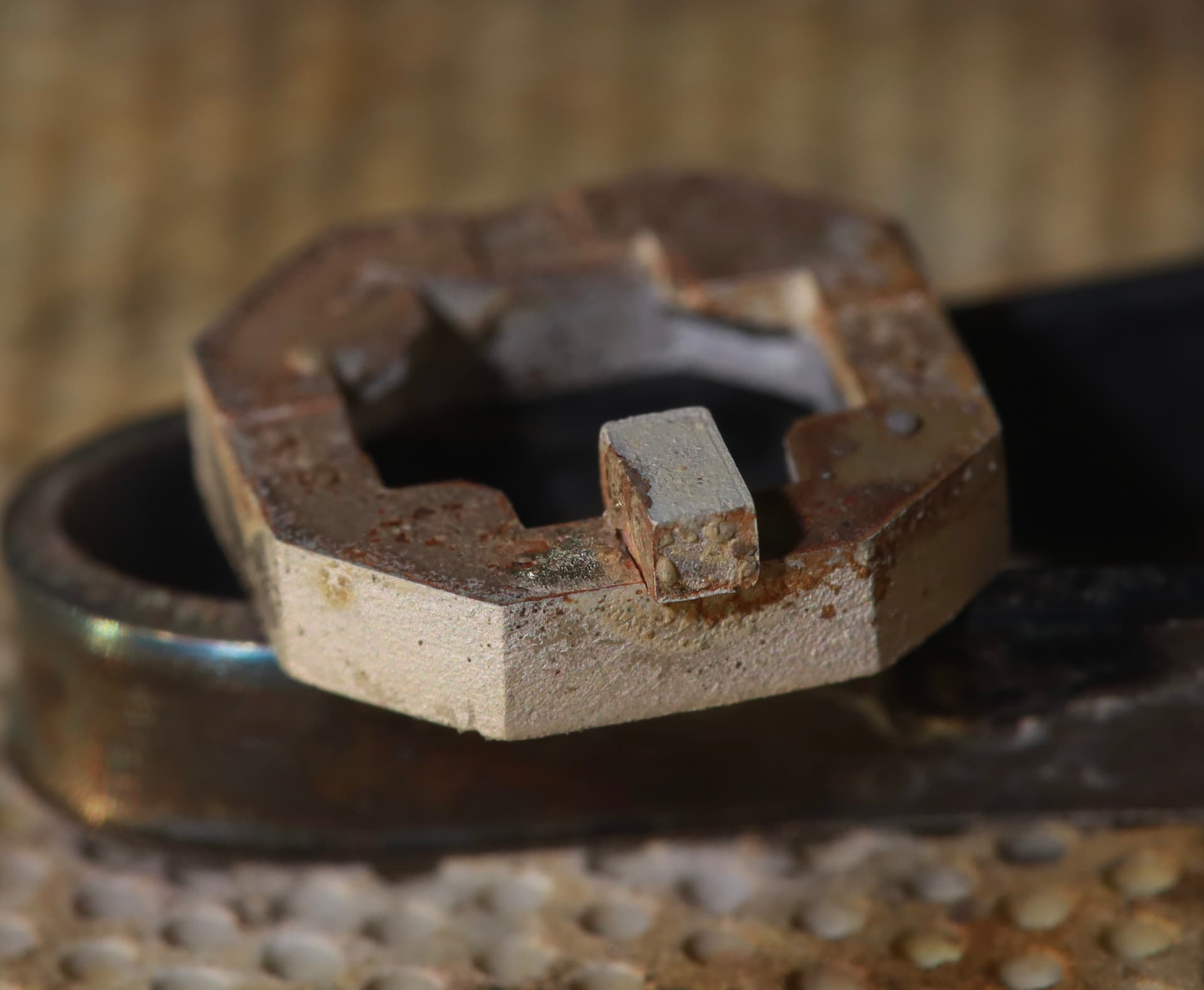
Since a few days ago I’ve been battling a soldering issue I can’t seem to overcome. I cut channels into the base plate in which I fit another piece. Even though this small piece seems to fit very well into that channel the solder doesn’t seem to want to flow beneath it no matter what I try. Always fluxed well, heated from the opposite side, heated from below, tried to push the solder towards the channel, the solder will either run up the wall of the small piece or melt on the base plate without flowing between the small piece and the base plate.
I might be completely off base here, but it seems to me the problem is controlling the flow of heat on something this large and maybe the torch is not big enough or spread out enough to heat the piece uniformly to let the solder flow where you want it. I would clean the piece really well, flux everything, place pillions of solder underneath the small piece and then fire it in a kiln to the melting point of the hard solder. Just a thought..
I agree with Kuchta.300 that the solder is flowing towards the heat, so if the solder isn’t flowing where you want it there may be a little bit of a heat control issue.
Have you considered rolling out your solder (flat) so that you can place it underneath the piece you’re trying to solder into place? You could also sweat the solder to the bottom of the piece. That way the solder is already half-way to where you want it to be and there’s no need to coax it into place. Once that solder is ready to flow, capillary action will pull the piece into place. It’s the coolest thing
You say the piece is getting plenty hot, but remember that the whole piece doesn’t have to be hot enough for solder to flow. Heat up the bulk of the piece, and then dance the flame around the cube, but more on the underside of your cube. Watch your flux at the seam. Once it goes glassy, focus more of your heat on the underside of the cube. Keep your torch moving. You’re trying to get that larger piece up to flowing temp in the area of the cube. Once you’ve done that, the solder should flow. When you see that happen, move your torch to the top of the cube, to pull the solder up into the side seams.
Good luck and please keep us posted, it’s an interesting design!
Many of us use Little Torches. They are great for much of what we do, but sometimes you need more heat and a bushier flame. I would clean all the pieces in hot pickle. I keep a small cup sized pan to do this in and heat it with an EZ torch. That way you get rid of any glassy build up from previous soldering attempts. Liberally flux the joint and smaller piece and pre solder the channel. Place the smaller piece in place and apply more flux. Then get out a bigger torch. I use a Meco with the MX casting tip when I need a lot of bushy heat. Bring everything up to soldering temperature. Be prepared for the smaller piece to move out of your desired position. There are various gravity types of devices that you can make that can help you keep a piece in place while being soldered. I realize that we don’t all have multiple torches. You might look for a large butane torch like the Blazer 2000 and use it in tandem with the Little Torch if that is what you have. I also keep 3 small pin vises with easy, medium and hard solder wire in them. Make sure to put some indicator of what solder is in each pin vise so that you don’t get confused. I keep one ready to add a little more solder via touch soldering just in case there wasn’t enough in the presolder. Lots going on here. Good luck…Rob
I had the same thought as Pam…sweat solder into the channel, pickle, file the solder a bit flat at top, reflux both pieces, then put the small piece in the channel…heat from below…the small piece will heat up faster and draw the solder onto itself…
soldering a large chunk of metal to a much smaller one, will always present some difficulties. The smaller piece will heat up first and draw the solder to itself. If you are using a torch, you might not be getting enough heat to the large chunk of metal before the smaller piece overheats. You could overcome this by using a torch tip with a higher heat output. A large brushy flame with high gas flow directed to the large chunk of metal could solve this problem… torch tmperature output is less important than total heat ouput. This suggestion is basically the same as Pam’s.
Interesting thing. I noticed something and put together a simple version but from another metal batch. I can solder this one successfully just like I expected so the reason now I believe is…acid being contaminated. A while ago I had to replace it since it got contaminated by iron. And I guess the same thing happened here, this is a piece of metal that was bathed in that acid. And every time I heat it up the contamination (copper oxide?) will make it to the surface and blacken the metal and the solder doesn’t stick.
Will produce same shape from another metal batch and come back with the result but I think that is the culprit.