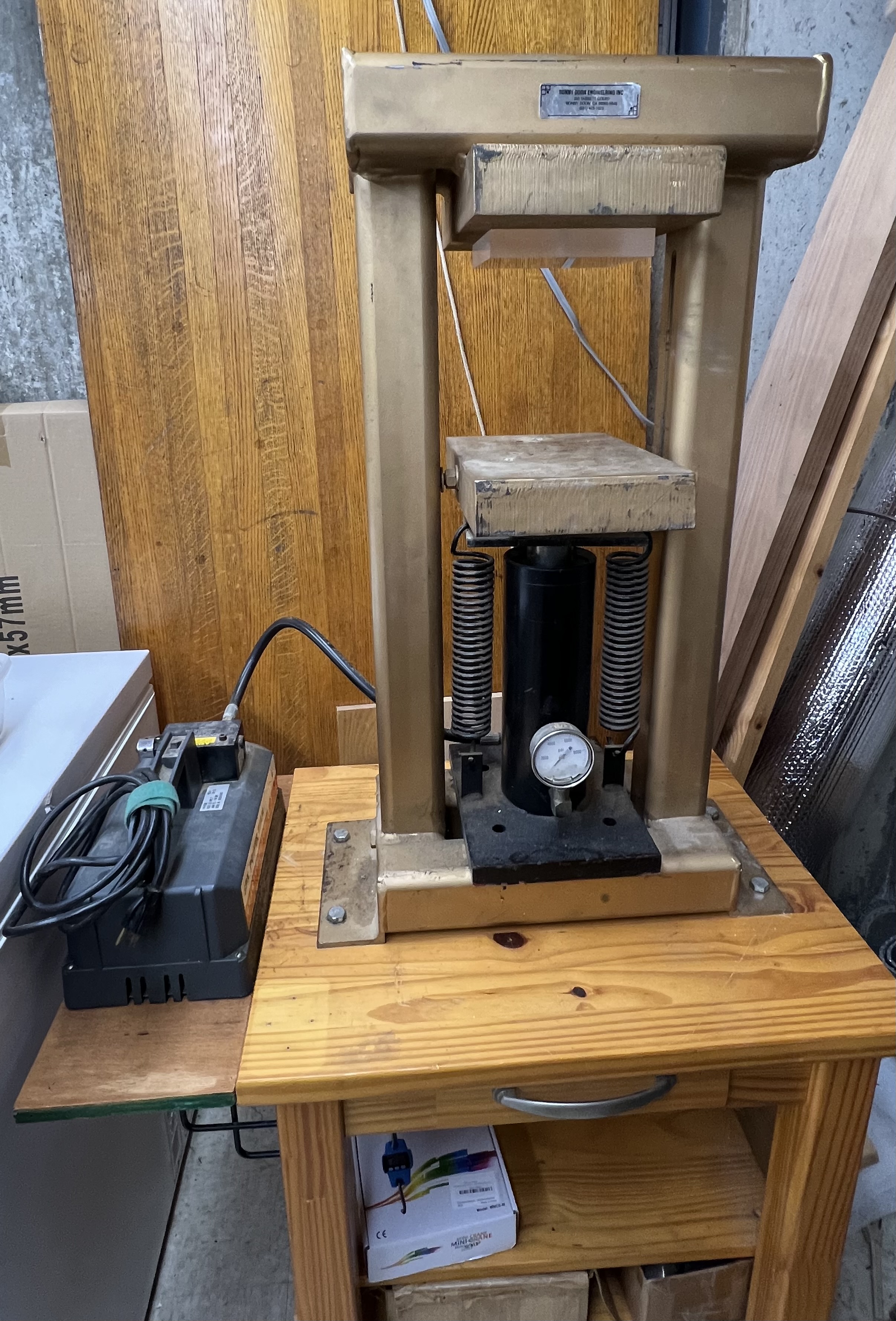
I think that’s pretty cool! You’ve got a little bit of contemporary metalsmithing history.
I think you know, but just in case, that acrylic protector does two things. It’s protects the platens and also acts like a spacer to help keep the ram from being fully extended.
Cynthia Eid mentioned face plates on the risers. You should definitely use those. The only problem is they only make them in 6"x6". They’re Kevlar plates.
The problem is that acrylic can potentially shatter and shoot out like a plastic bullet, which can be very dangerous. If your press has an unprotected acrylic spacer without the Kevlar layer, it’d be best to remove it and figure something else out.
Here’s the 6"x6" Kevlar face plate that Rio sells. I’ve seen students do dumb things three times in my career and shatter the acrylic even with the Kevlar face plate on. No one got hurt, but it could have been bad.
That’s fantastic that your press came with accessories.
I wouldn’t worry about the welds. I’m confident that Lee built a solid press that will outlive us all.
Donna, Until your bottle jack gets repaired, like others have said you can use an inexpensive hand crank bottle jack that is the same size. It’s not that hard to estimate the power without a guage. Use the least amount of strength necessary crank up your temporary bottle jack to accomplish your task. If you’re using all of your strength to crank the jack, you’re going too hard.
That’s a bummer about the rubber cap disintegrating! I don’t know if there’s a Harbor Freight or discount tool dealer in Hawaii, but that’s a good source for an inexpensive bottle jack.
Here’s some instructions to build a hydraulic press from an old Ganoksin thread. It tells you what you need in a bottle jack ram.
Thanks for the info on the plates/protectors. I saw Rio had the kevlar; just ordered a set. (I had planned to use 3/4" thick aluminum slabs both as spacers and protectors.) I noticed that the paint has peeled off in spots on the top platen - I’ll probably clean it up and repaint.
We successfully weighed it. The press alone (w/o the acrylic ‘protector’) weighs 275.3 lbs; the pump is another 21.8 lbs. No wonder two strong guys couldn’t power lift it.
I’m late to this thread, but I think I have that exact press. It is gold and like 30 years old. I have the electric version and I had to buy a new jack for it. I think I have an old typed up manual of some sort and can check for it when I get home. Reach out if you want more help. I did a ton of research when I bought her and she sure is a workhorse in my shop now.
Bernie
Caroline, This won’t answer your specific questions, but here’s a link to Potter USA’s hydraulic press boot camp: https://potterusa.podia.com/
Potter makes a 20 ton press and a variety of press accessories. The owner,
Kevin Potter is very accessible. I have no doubt he’d be happy to answer all your questions. If you’re on FB, they have a Potter USA group. Post your question there for additional input.
Good luck and have fun with your new press!
Bernie, how difficult would it be to scan your manual? I’d LOVE to have a copy!
I’ve been following instructions from PotterUSA on using their 20-T press, and downloaded instructions for the pump. All of that has helped, but a copy of your manual would be amazing. Thanks.
Thanks Dianne, I’ve been a member of PotterPeople for a couple of years I think; that was what prompted me to search for an affordable used press. Yes, very informative, very helpful bunch of folks.
I used an industrial scale while the press was still connected to the block & tackle. Set it on its table, inserted the scale in between the press hanging loop and the b&t, then hoisted it again with the scale on. Something like 300 lbs with pump; our bathroom scale wouldn’t have been able to handle that.