I have a question about anvil height for jewelers. A friend asked me to verify her research about what height to make her anvil and I replied that the face of the anvil should be at knuckle height when your arm is hanging straight down.
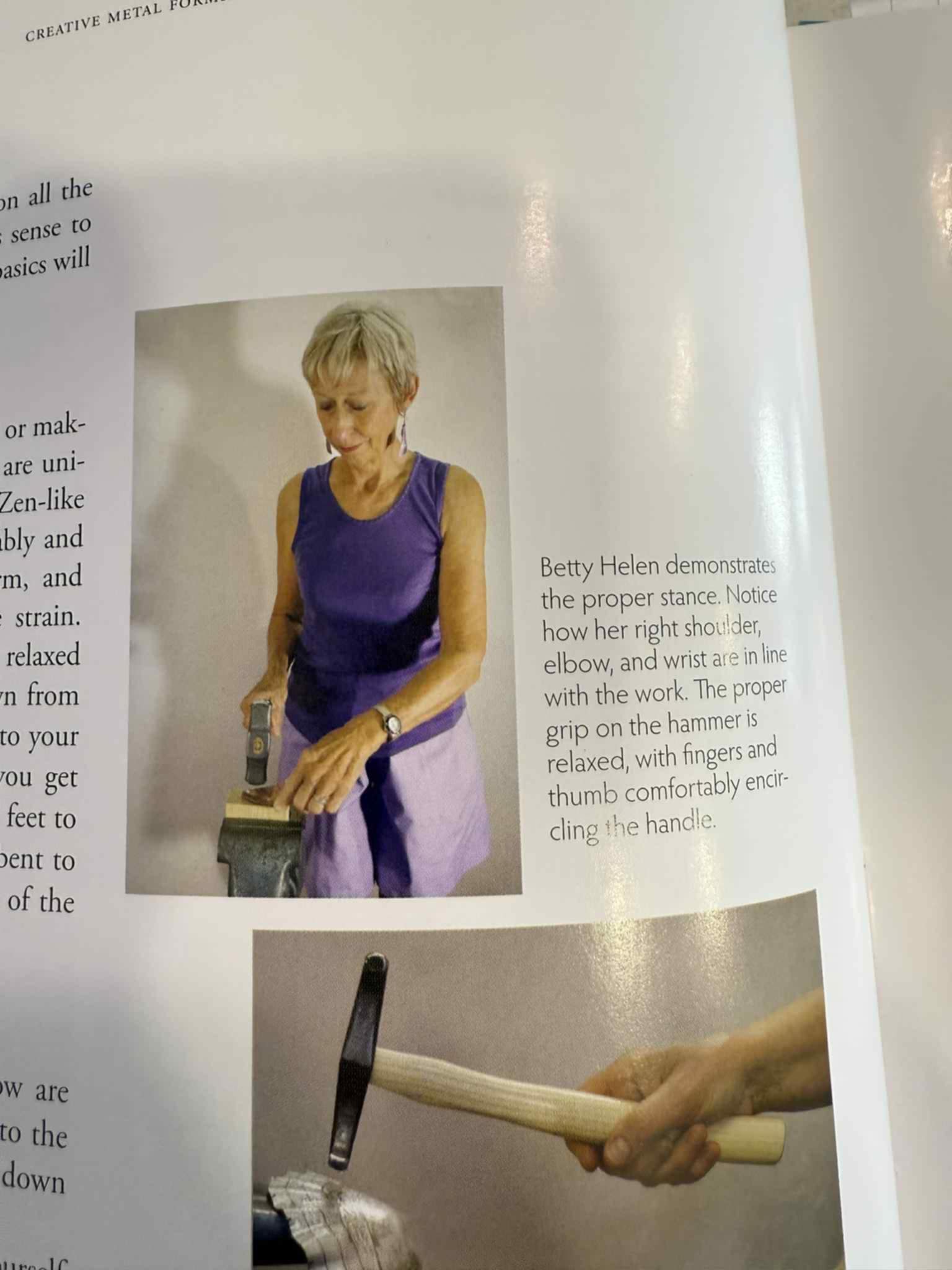
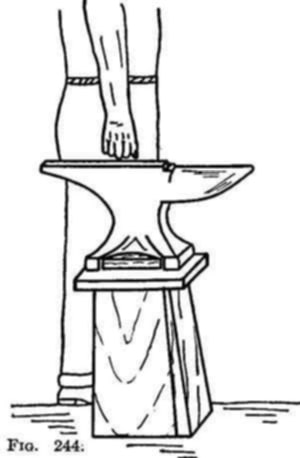
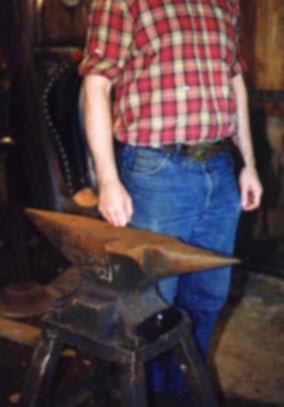
This was not what she had seen in a couple of jewelry sites and books. It seems that the correct position is such that your arm is always slightly bent, supposedly to place less stress on the wrist and shoulder. I am including the image she sent me (Sorry, I do not know which book this is from) and a couple from the internet about anvil height for blacksmithing.
My anvil height is such that my arm is almost straight with every blow while forging out silver and gold stock. When doing raising, I have a lower vise to hold my stakes and I am still almost always straightening my arm with every blow.
So which is more ergonomic? To me NOT straightening my arm seems like a crash course in how to cause strain in your arm. She seemed certain that straightening her arm would do more damage than good.
Different teachers will teach things slightly differently, so I am unsure if I am wrong or is this just a matter of how I was taught and both techniques are safe and legitimate?
My main forging hammer for iron and steel is about a pound or a little more. My hammers for raising, sinking, and forging jewelry metals are much lighter as I feel the weight and momentum of the hammer does the work and I am mostly guiding where it strikes.
The image she sent me was “the proper anvil height per Longhi and Eid”.
I learned differently, I think, because I was learning from blacksmiths.
So I wanted to see what other jewelers think. Let me know what your anvil face height is and your height. Give me your opinions as well on the ergonomics of hammering, forging, and raising metal.
I am 6 feet tall, and my anvil face is just about 30 inches tall.
Thank you in advance for answering my question.
2 Likes
I do a lot of forging sitting down…Rob
3 Likes
I think it matters what you are doing with your anvil. Like Rob I do a lot of forging while I am sitting.
Swadging the shape of forty or more bracelets will require a different height on the anvil face. The height of my stool is adjusted up so I can keep the top of my anvil equal to the height of my elbow. I will stand when I am forging steel but I will try and keep that height with in an inch or two of the sitting height
I don’t do any raising or sinking of vessels and that may require a different height than a forging anvil. I don’t know what’s right for stakes. I imagine preference may have as much to do with the height of work surfaces as anything.
Don
4 Likes
It’s important to note that the first photos show her sinking and raising, not heavy forging of an ingot.
Blacksmiths, by the nature of the work, use more force to move the metal than jewelers do. The lower height of a blacksmith’s anvil allows for a longer stroke thus letting the hammer gather more kinetic energy as it falls, doing most of the work.
IIRC, the stakes in the silversmith studio at FIT were set at about kitchen counter height, and the students could work either standing or on stools.
5 Likes
Elliot_Nesterman makes a good point. A blacksmith anvil height and set up may be different from a silversmithing or a jewelry set up.
I was taught the general guidelines shown in these images. When standing the anvil height should be close to the height where the arm is extended and the fingers touch the top of the anvil in a loose fist shape.
When sitting for jewelry forging and shaping, folks have taught me that the ideal anvil height is for the your arm to be at a right angle when the hammer touches the anvil. This height can change depending on how long your hammer head is. Some silversmithing hammers are long. Some are short. That means having an adjustable height chair can be very helpful in keeping your arm hammering at a right angle.
No matter what, these are guidelines, not hard fast rules. Your body will tell you if you’re not in proper alignment. So be sure and listen to what your body tells you.
Hope that helps a little bit!
Jeff
4 Likes
I can testify about the importance of ergonomics. I worked in a museum blacksmith shop where the anvil and forge blower were set up for someone 3" taller than me. By an accident of scheduling I worked eight days in a row. Just after that I lost 3 months to physio therapy: nerve impingement from cranking the too tall blower. Couldn’t tie my shoes.
Too high hurts joints; too low hurts your back; but high is easier to fix. Build some kind of portable riser step / apple box. (I use steel scaffold tread) Keep in mind that forge work is not just the height of the anvil. Top tools, punches and swedge raise the target height considerably.
4 Likes
I have the old stool from our dad’s shop. Don has the bench. The stool is cast iron with one of those seats that screws up and down on a course threaded steel spindle. It is so well machined and lubricated that it doesn’t matter where I leave it, by the next day it will screw itself down just due to gravity. I have cut a series of different length PVC pipe that will fit over the screw shaft and limit how low the seat will go, depending on what I am doing. I could buy a new stool with and adjustable height, but I kind of like using dad’s old stool…Rob
5 Likes
I have learned the book image is from “Creative Metal Forming”, by Longhi and Eid.
1 Like
to paraphrase “white rabbit” - “one size makes you smaller, and one size makes you tall, and the size mother gives you doesn’t do anything for you at all. so ask Alice when she ten feet tall.”
Do what is most comfortable and puts the least stress on your joints and muscles, particularly your neck and shoulders. I had to quit making jewerlry due to neck and shoulder problems 20 years ago. Part of it was because, and again to paraphrase Mick Jagger “I have nasty habits, I take tea at three.” That aside, adjust your anvil height either by stool adjustments or anvil height. Sitting at a bench for hours at a time takes a hard toll on your neck, shoulders, upper back and lower back… Don’t do it if it hurts!
3 Likes