I normally work with Sterling and Fine silver. But I picked up an old Rogers Silver plated set to try and make spoon rings and the like. My scavenger mind asks - is there a way to capture the silver from the set if I had it refined or am I just looking at bending and cutting these pieces up for plated jewelry?
There isn’t much silver in plated pieces. Check with some refiners and see what they say…Rob
2 Likes
I am of a mixed mind of using flat ware for jewelry altho I have done so myself. The high price of silver scrap and families with inherited Sterling flatware means a box of table wear off to the big melt and a check in the mail. I will occasionally buy flatware so worn out or damaged it can’t be used. I’ll usual make sheet out of the spoon bowls. And I have a product I make out of the handles but they are not rings.
The silver plate can be soldered and worked with in many ways. The soldering damages the plate pretty good but it can be a part of the finished product.
This octopus is made of a couple forks. Instead of polishing this guy was tumbled and he brass brushed. And better still it was fun to make. One down side I noticed is you can blow through spoon bowls because of the different melt temp. I don’t know about soon rings from silver plate. But give them a try.
Don
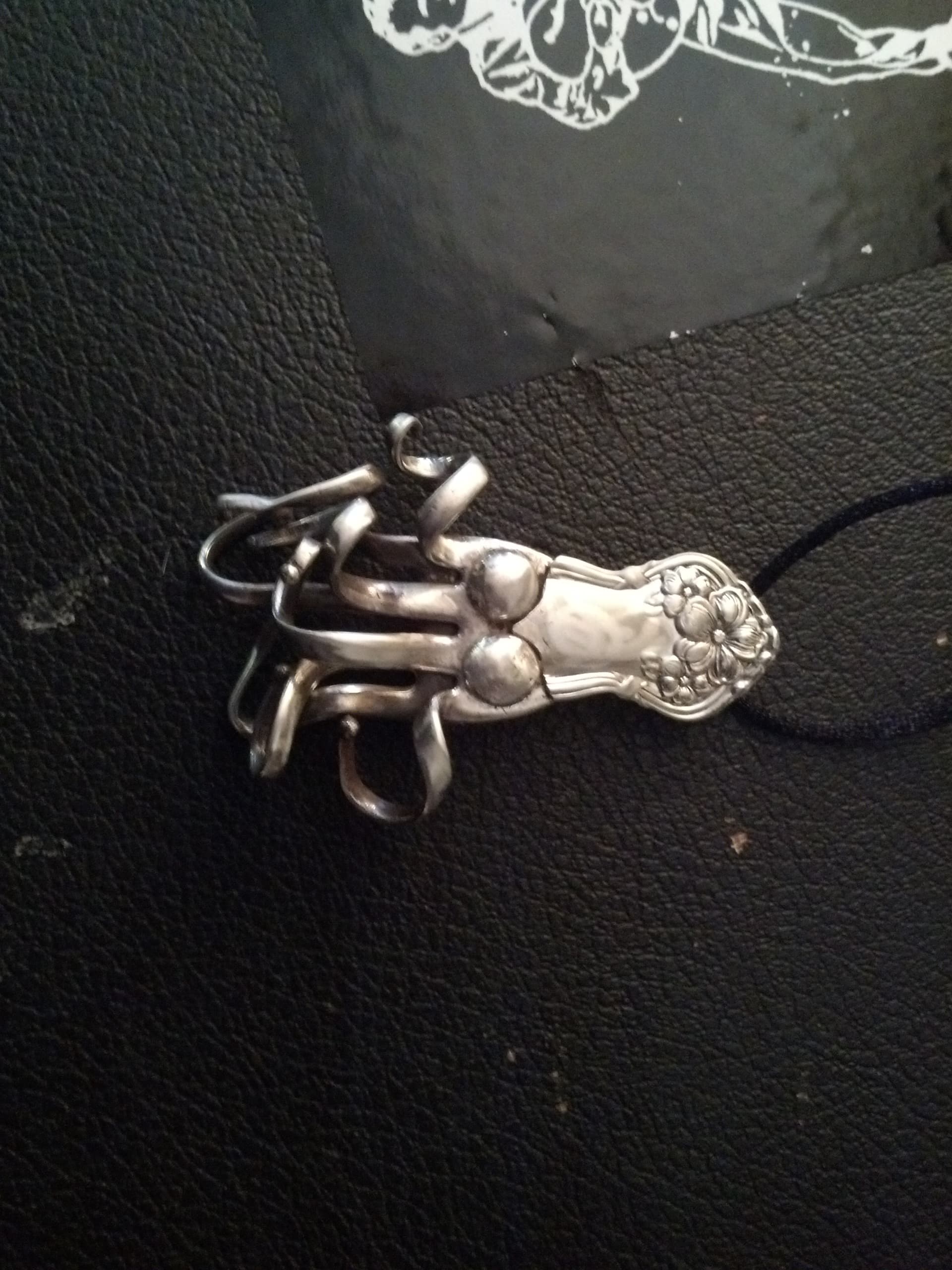
2 Likes
I checked with Elemetal, when silver was about 22$/toz. They offered $3.50 per pound for plated hollow ware. Probably a bit more now if they will even take it.
As to making things out of plate - either design so it doesn’t need solder or use a PUK (TIG welder).
1 Like
Hi Celia:
According to the Canning Handbook on Electroplating the best tableware silver plating is 0.002” thick and called Hotel grade. The ordinary grade for house use is only about 0.001” thick. By estimated the surface area of the article you can ballpark the volume of silver and using the silver density (10 time of the density of water) you can guess the weight of the plating. Just as a trivia, it take hours to plate the Hotel grade !!
2 Likes
Flatware can be cut into pieces and dissolved with 50% concentrated nitric acid. The resulting solution will contain silver nitrate and base metal nitrate. Add Hydrochloric acid (muriatic acid) to the solution will convert the silver nitrate to silver chloride… The resulting silver chloride must be repeated washed by decanting, adding water and decanting repeatly until there’s no blue copper solution or base metal solution left…The addition of Lye (sodium hydroxide) will turn the solution black with silver oxide, the addition of sugar as concentrated sugar syrup will reduce the silver oxide into metallic silver. The silver flakes are again washed repeately by decanting and adding water, decanting again.. the final silver flakes can be filtered and trapped in a fine meshed paper filter (coffee filters won’t work, the mesh is too coarse).. The final step is to melt down the powdered and flaked silver into fine silver metal lump in a melting dish. This is not a home project without laboratory glassware and fume hood, and personal protective equipment. This process is dangerous.. fuming nitric acid gives off brown nitrogen dioxide fumes when reacting with metals. The fumes are extremely corrosive and toxic. Concentrated muriatic acid also fumes. All chemical processes including cupellation costs too much money to be worth it.
Reverse electrolysis is another electrochemical process that might be worth using instead of chemical methods. If you already have a plating setup, the process can be reversed by using a thin silver bar as the cathode.
I have done this outdoors and an experiment to separate gold plating from a silver base in medical electrodes. The electrode base is fine silver, a thin plating of gold is on the surface. This experiment did work, it separated the silver as silver chloride. The gold was thin as gold leaf. Removing the gold was nearly impossible as it was so thin and fragile. The amount of gold wasn’t worth the effort and cost of reagents- nitric and hydrochloric acid. The silver also was precipitated as silver chloride. Silver chloride can be directly reduced into silver by heat… this process drives off chlorine gas- another toxic corrosive gas…
Using this chemical process to strip of silver plating from the base metal beneath may not be worth the time and cost of the reagents needed. With the high price of silver, you might be able to break even or turn a small profit from this chemical process. However, the price of acids have also gone up.
Sending the plating and other precious metals to a refiner is the best way to do this. Elemetal Refinery accepts silver plate.
2 Likes
It will not make economical sense to dissolve the base metals with Nitric, and if one is to treat it this way 25-30% is better as it will hold more metals.
And the way to go after is either as you have noted, via Silver Chloride or cementing on Copper.
The Copper route will create way less waste to treat.
Many will however treat it either with a Sulfide Cell, water Cell or with a “Melange” of concentrated Sulfuric and a small amount of Nitric.
The Sulfuric will passivate the Copper and some other base metals and the Nitric will dissolve the Silver.
Anyway, if one can send it away, that make more sense than building your own lab for this.
2 Likes
I absolutely agree with you. Sending flatware to the refiners is far more cost effective than trying to do it on your own. The cost of the acids outweighs the value of the recovered silver. If anyone is to try a chemical method, it requires too much equipment and reagents to make any sense. My experiment to separate gold plating from silver was not worth the time and not worth the cost. I did it as an experiment only. Reverse electrolysis/electroplating on a silver cathode may be the only home way to go.. Sending it all to a refinery that accepts flatware is the only way to go..
1 Like