Hi Julie!
Thanks for all the great suggestions!
I bought a bunch of rotary bur stands in different colors with clear covers for storing accessories like Cratex, Dedeco, and 3M wheels; my treasured set of Agilo Cabshine wheels for intaglio and stone carving work like my recent daisy flower cuff bracelet project with faceted citrine center and flower petals individually carved from white jade, and leaves carved from dark green nephrite jade. These also store my graver polishing wheels; bristle brushes and wheels, etc. These stands stack, and I have shelving above my bench where they can be stored out of the way when not in use.
I used power tools to convert a thrift store book case into a tall hutch that sits on the back of my bench. There’s enough space under the lowest shelf (20”) to allow my import Leica clone microscope to slide under it when not in use without hitting the long led light fixture attached under each shelf – I often work evenings and need lots of color-corrected illumination for aging eyes. Instead of drilling holes in my bench and permanently bolting the microscope to it, I bolted it to a wooden base. This enables me to slide it forward to the edge of the bench where the adjustable arm can be easily pulled out over my 5” ball vise sitting in the catch tray when I need to do stone setting or engraving, then slide it out of the way and store it under the bottom shelf of the hutch at the back of the bench when I’m done.
I segregate used buffs and wheels by grit and store them in a drawer unit in plastic zipper bags along with the compound I used on them to prevent abrasive grit cross-contamination. (Don’t ask! Yes, I’m human, yes, I made that mistake early on, but it only took one time around to learn that painful lesson).
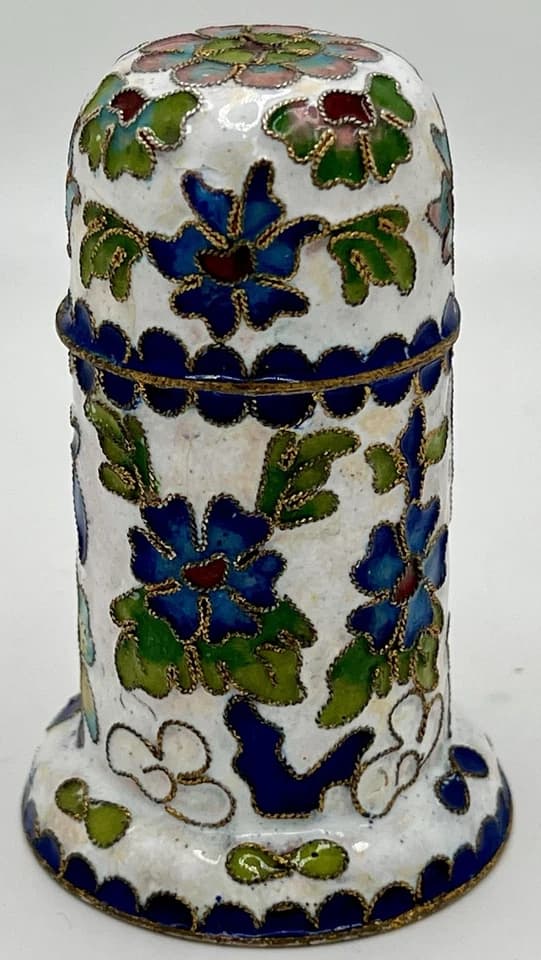
Like you, I have dedicated wooden stands for sharps like scribes, tweezers, dividers, punches, etc. I also use a set of four fancy little vintage enameled copper trinket boxes to store shop-made sanding twigs I make from toothpicks, rock tumbling abrasive powder, and CA glue. These trinket boxes were a gift from a family member that knows I enjoy doing cloisonne enamel work. As it turned out, they’re perfectly sized to hold a good supply of these toothpick sanding twigs, and each of the four holds a different grit of twigs that are easily distinguishable by the different colored trinket boxes. This white one holds the coarse grit:
As a former closet tool addict that has now come out of the closet, I have a self-admitted fetish for metal measuring sticks and layout tools. However, they must all be Starrett brand to ensure consistent, reliable precision traceable to NIST standards.
I have tiny little 2” adjustable precision toolmaker’s No. 14 squares, one with an inch rule, another metric. I have larger No 13A 4” double squares with replaceable inch and metric rules along with an ungraduated rule having angled ends, one 30 degree and the other end 45 degree. I have still larger No 13C 6” double squares with replaceable inch, metric, and angled rules.
I have hook rules in various styles and sizes in both inch and metric. I have flexible steel rules in 6”, 9”, and 12” length, equivalent metric rules, and some rules with both inch and metric graduations. I even have a couple of Starrett #62 rule holders of the type used on a precision ground granite surface plate (yes, I have one of those too, along with surface gauges and a height gauge I use for layout and metrology work).
I also have Starrett layout tools including dividers in multiple patterns (flat leg, round leg, Fay pattern, etc) and sizes from 3” up to 6”, protractors, a No 47 universal bevel and a No 49 multi-angle bevel.
I have enough other toys to go on for quite some time, but readers are likely bored with this post and I’m embarrassed enough by my admission of tool gluttony to stop for now. The post was supposed to be about storage, not tools. I keep most of these toys stored away in drawers in my workbench, but a few stay out on the bench all the time because they’re used daily, such as the tiny No 14 precision toolmaker’s square with the metric rule, and my 6” Starrett metric dial caliper.
I too coveted a big powerful floor-standing drill press for many years. I just couldn’t bring myself to pass up a deal to buy a used but like-new top brand model at a great price. But less than a year later I sold it. It was overkill and took up too much valuable floor space in a machine shop already having multiple machines capable of drilling holes. These include a Sherline tabletop mill and lathe, a HF mini-lathe, a Jet bench lathe, a Delta bench top drill press, and a large 220v 3hp Jet mill-drill with power feed having enough torque to drive a huge 1.5” diameter Silver & Deming twist drill through a 2” thick block of alloy tool steel without breaking a sweat.
Over the course of more than two decades worth of machining experience, I’ve discovered there are vanishingly few jobs requiring more power or capacity than my trusty Delta tabletop drill press has. Then it’s both cheaper and safer to just farm those jobs out to a local machine shop…