I have a recessed bench top to catch filings and sawing particles of precious metals… kept it clean between each project, sweeping with a house paint brush… amazing how much dross and dust, steel fragments collect when swept up…used magnet to pull out the steel particles and washed and dried the filings, sawdust and house dust washes out easily under running water… filings and small scrap pieces saved for later melting…zinc content slightly higher from solder…the melt can be superheated to burn out the zinc in a melting dish but not too muchas copper burns out also with oxyacetylene…Did all my melting outside… fumes, burn gases…don’t have a fume hood.
@jsfandskh I don’t know why I have problems now either! Can’t tell you how frustrating it is to have a porous piece of wire that keeps breaking when I weave chain. I have been practicing with lower temps and the ingots are coming out a lot less ‘porous’. I have to keep practicing as the metal tends to freeze before I complete the pour. I will continue with open faced mold as I spent a decent amount on mine, besides, I see so many people use them. Will keep you posted.
1 Like
I do not know how it has evolved at this time,
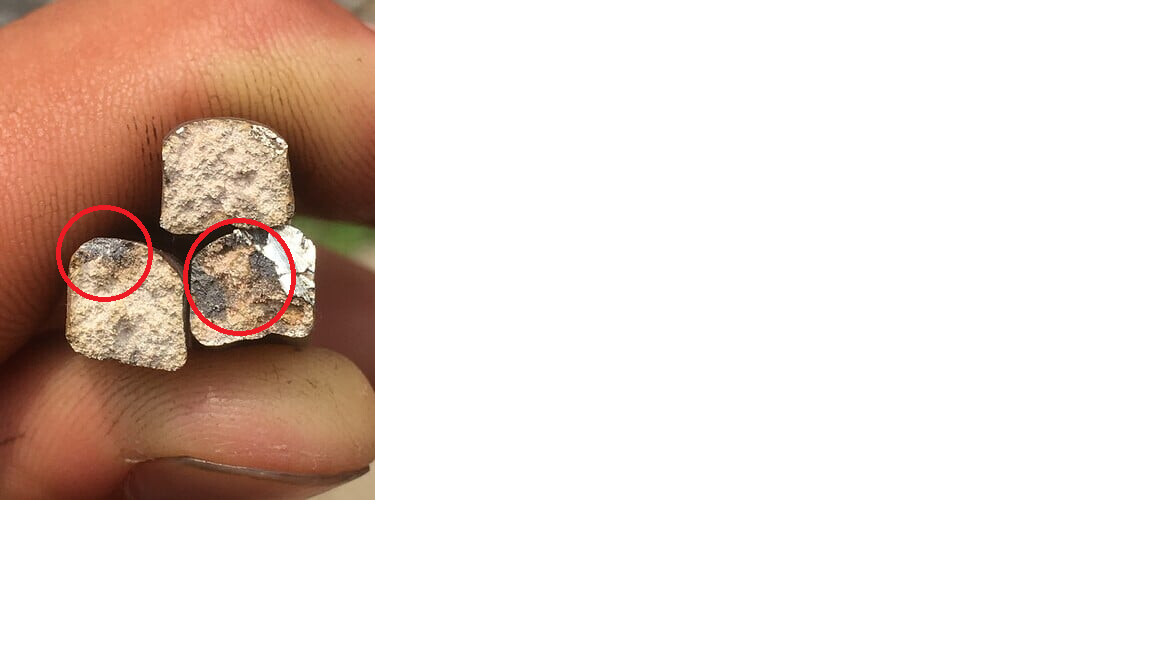
but the initial picture shows significant pollution/inclusions.
Carbon or similar I’d guess.
Check the highlighted areas.
Maye the metal should be properly refined before reuse?
porosity in silver can be caused by excess oxygen. make sure you melt with a reducing flame if using oxgen gas mixtures. melt quickly on high heat… open faced molds let silver absorb oxygen from the air…molten silver absorbs up to 20 % volumn percent oxygen… if the ingots are porous, the roll and wire will also be porous…use casting flux or powdered chacoal to coat your mold and sprinkle it on top as soon as it melts to absorb oxygen out of the metal…
also have to agree with previous post that areas of discoloration could show pollutants…
have your tried a new pour with a clean batch of metal? If the problem persists, I wouldn’t know what else can be wrong…
you could be on to something… looks really odd when enlarged.
Hi,
question: how much metal are you melting? and how long does it take to melt before you pour?
julie
@wldlzrd1 The melt sizes vary. From half ozt up to four ozt. Even my largest melts take only roughly 90 seconds with a double ought torch head.
That is something I thought. That particular batch is going to be refined, but I am using it to practice better casts.
1 Like
Get rid of the Rio silver scraps. I had a complaint with them a few years back. I had always worked my metal hot(30 years). I noticed on the batch that I ordered the metal started crumbling under heat. Called them and they said it was normal. So I had it tested with an xrf gun. There were other metals in their sterling silver, not just copper and silver. Everytime i would try to pour a bar it would crack and split. Had no issues whatsoever with gold. All this to say buy some fine silver grain and pure copper and alloy your own metal. This should correct the issue.
2 Likes
@MarkJamesDesigns I do have an issue with their silver fire staining very easily even with a protective coat. It also does not polish as high of a shine as home alloyed, I even polished two pieces the same and went around asking people and they always pointed to the home alloyed! Was a blind test.
I did not however know anything about Rios silver crumling in particular, will keep that in mind. Thanks.
hand held XRF machines cost a bundle? did you find a cheap one? did you find traces of arsenic, tin or lead in the silver? what trace metals were present? RSVP. Interested in finding a cheap one for other purposes. Tin and lead known to cause microstructural embrittlement.
Rio Grande is not a refiner but an intermediary… could be contaminated metal… MarkJamesDesign has an expensive piece of equipment… XRF hand held costs 10K… nice if you have one… but outside of my budget. Am very interested to see what he found.
Sometimes the old ways are better. Making your own alloy you know exactly what you have.
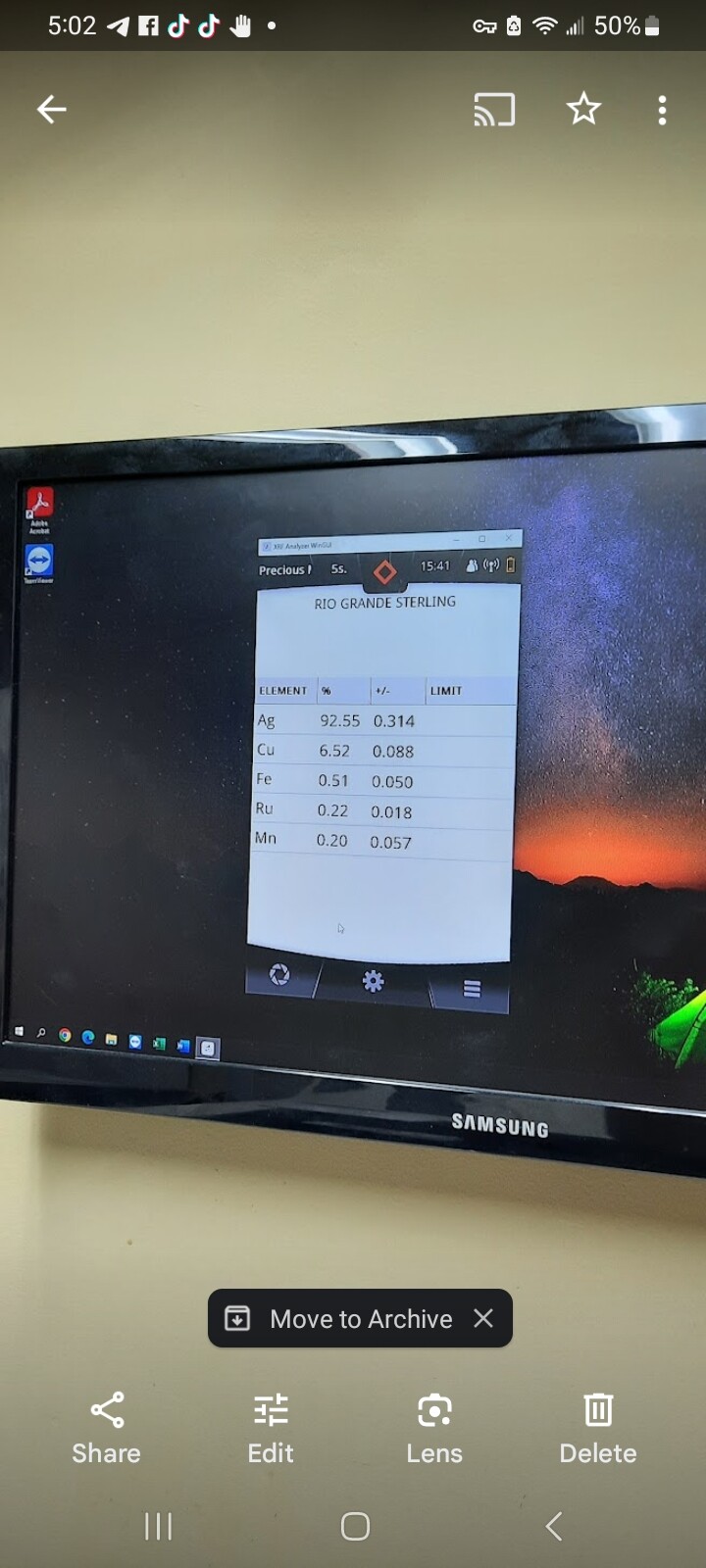
The refiner I use has one. After what I discovered with the metal cracking under heat I had them test it.
is the picture a display of your XRF readout? If I had one, I’d be testing rocks for elemental contents… XRF not sensitive to light elements like Si, Al, Mg… cut out all of the noise from common rock forming oxides… silica, alumina, magnesia for felsic and mafic rocks… If you have one, how much did it cost… I could amuse myself with an expensive toy… SHRIMP and LA-ICP-MS machines cost as much as an MRI machine and have the same 100K plus annual cost of operation… commercial labs charge 2-6K per sample… XRF great as a screening tool for heavier elements…
Yes that is the read out from the XRF gun. I dont personally have one. However the unit they have is $12,000.00 well woth the cost.
cost range I saw was 12K up to 40K… I’d rather spend that much money for a 1 month trip to Europe or Asia, maybe multi country tour with a trip to Vietnam and Thailand for gem buying.
The 12K model works at a lower sensitivity than more expensive…heavy element detection sensitivity is particularly low, in the tens to 100’s ppm…cheaper ones don’t have sufficient high energy X ray flux to excite the electronic structure of heavy elements, gold included, with heavier elements such as lanthanides and lead/uranium even less… none can separate isotopic composition… mass spect is the only way to do that… cost prohibitive even if sent to commercial labs.
The read out shown shows a lot of iron…could be that amount of iron, which is in excess of trace, could affect the properties of sterling.
1 Like
Finally someone who also picked up the cherry red annealing temp. That is hot!
It’s to be barely black-red viewed in darkness (under the bench), wait til black heat before quenching.
I’d also recommend an oxy-propane torch setup, forging all sides, file off any sharp parts and anneal again.
1 Like
The XRFs are machines and do what they have been programmed to, nothing more and nothing less. They have one feature that is “dangerous” though and that is that if they scan something that do not fit exactly to their library they guess what it is with what they assume is the closest target. Since most of the XRFs out there are in pawnshops and similar they are almost all set and loaded with precious metals libraries.
So if you are to use them on rocks (Not recommended) they need to have full libraries (Costly) frequent calibrations and skilled operators.
One common mistake we often see, is excited people with rocks that test high with Iridium and Rhodium which is in fact Arsenic.
To sum it up, it is a great tool but has to be used with great care and understanding to avoid the pitfalls.
2 Likes
thanks for the back up… I did say that cherry red was too hot… approximately 1,500F… a hundred degrees more, the sterling will start to melt… cherry red is submelting and perfect for crystallization. Dull red at 1100 to 1200 is optimal. A cheap hardware store propane air torch is more than sufficient for annealing and soldering.