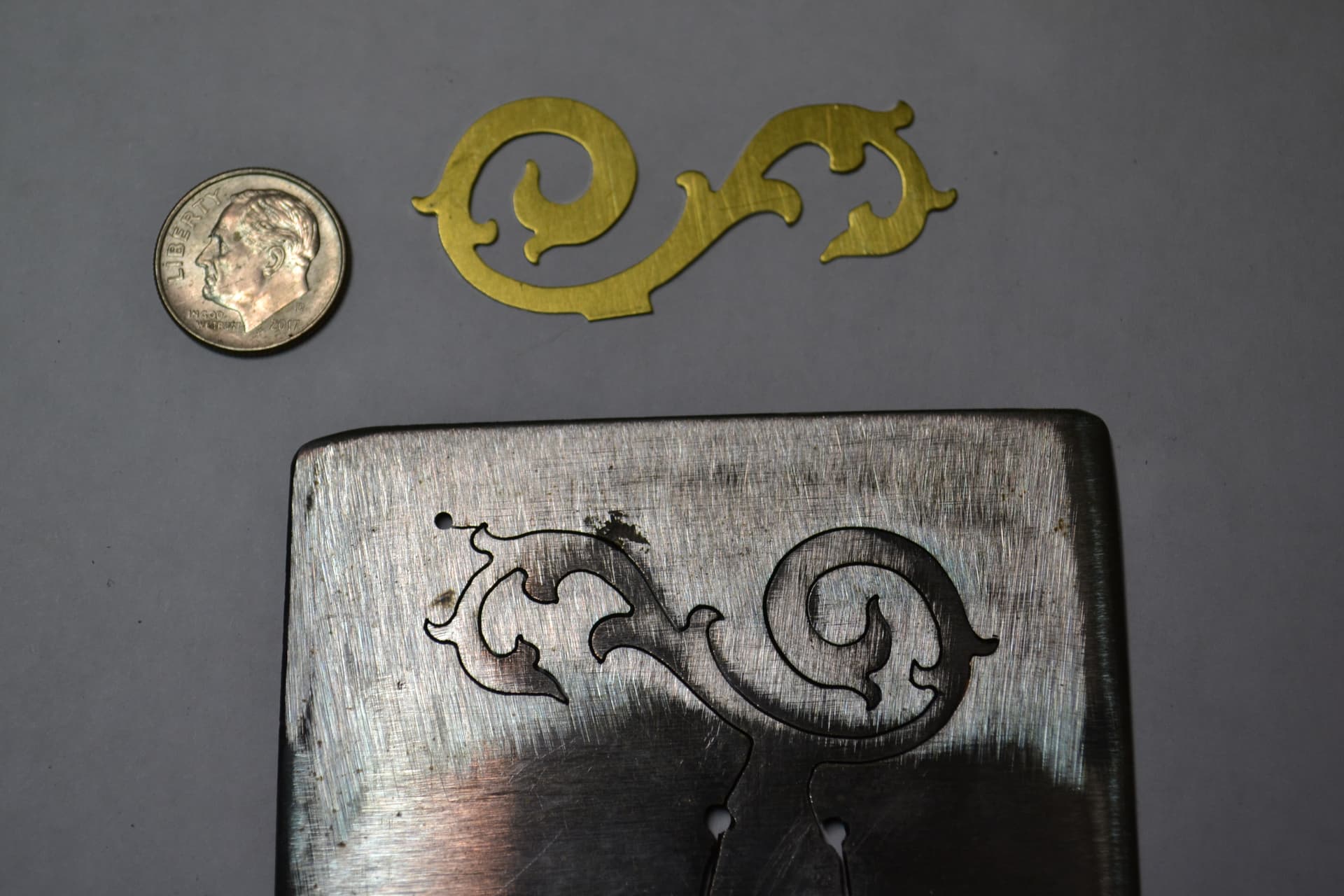
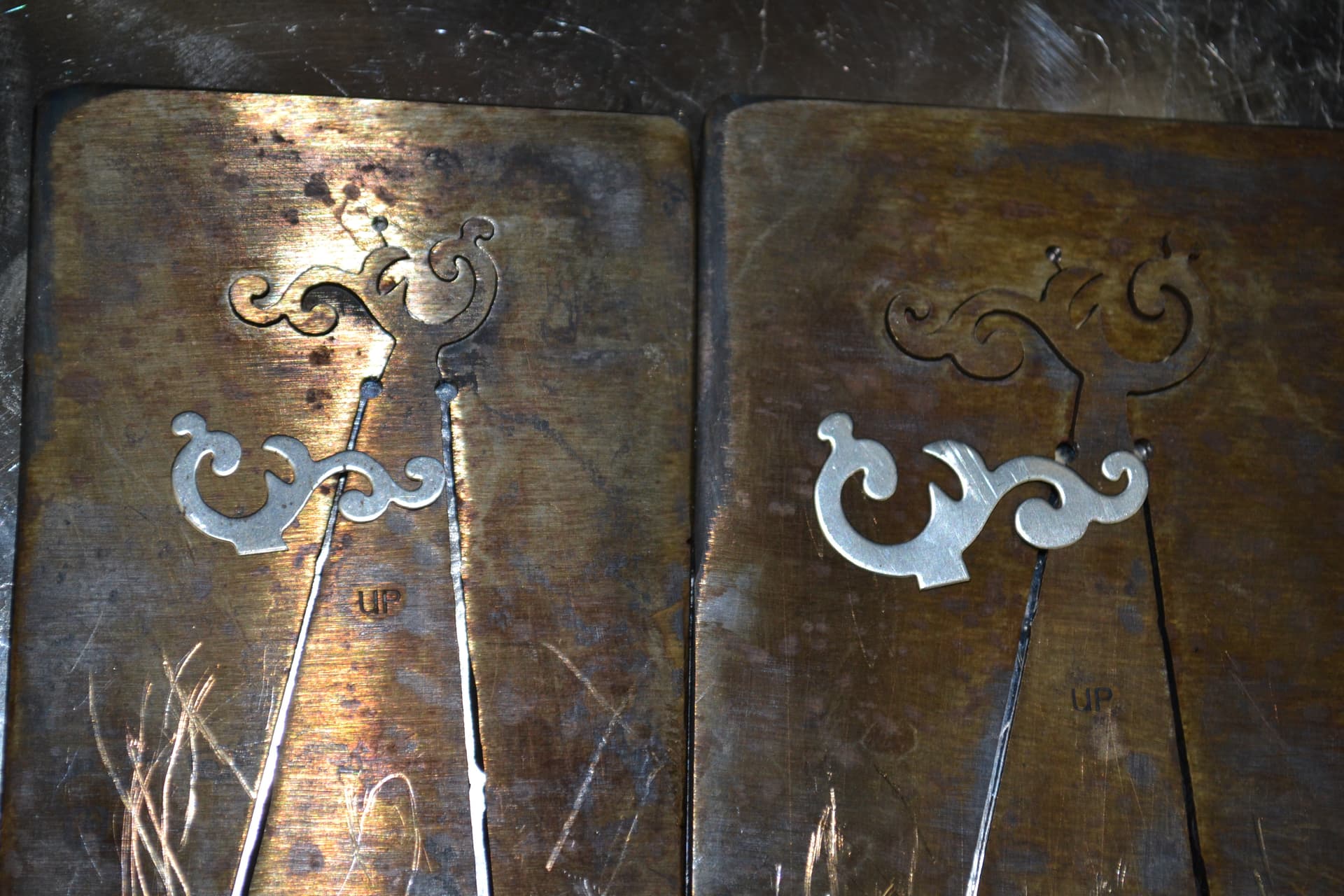
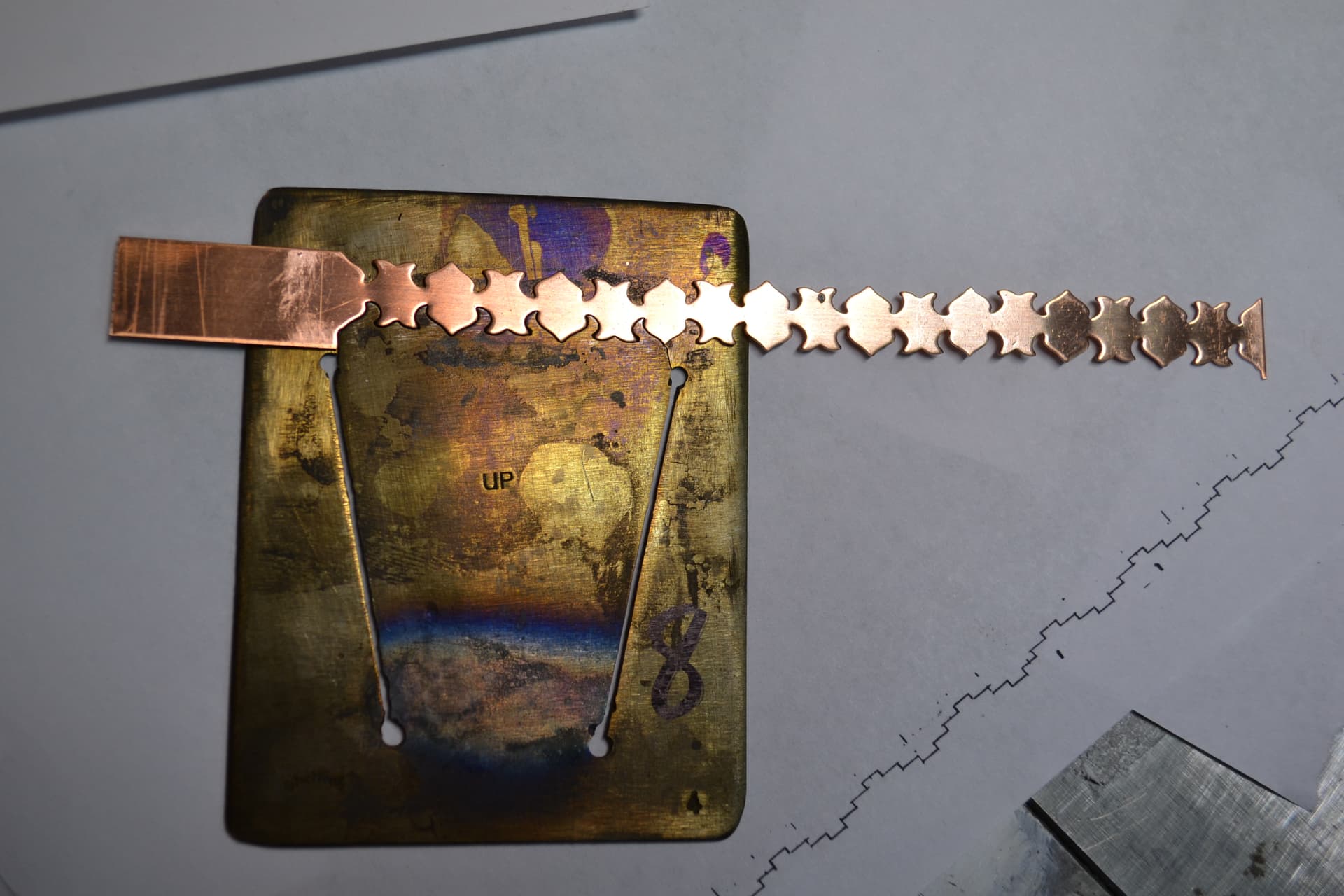
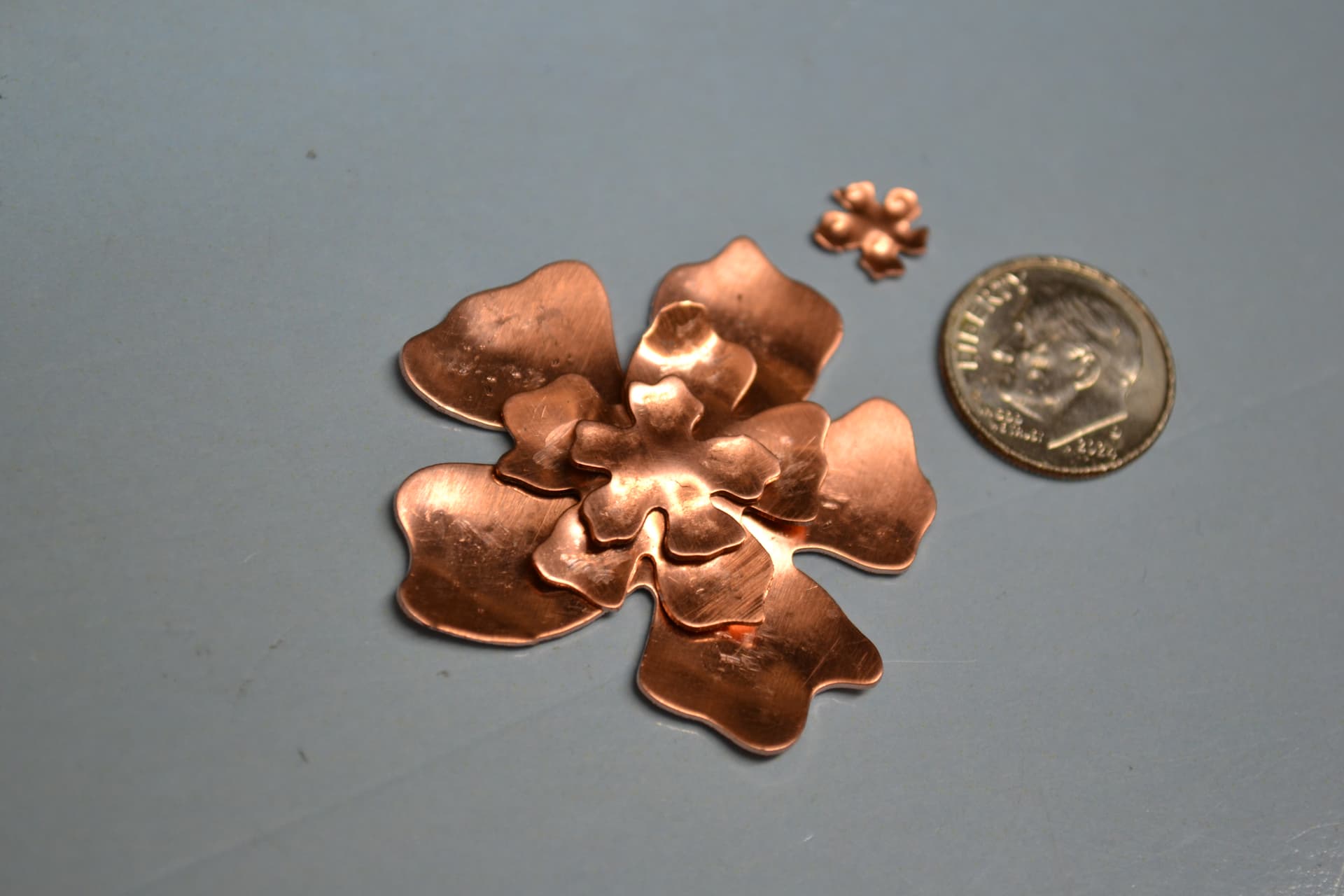
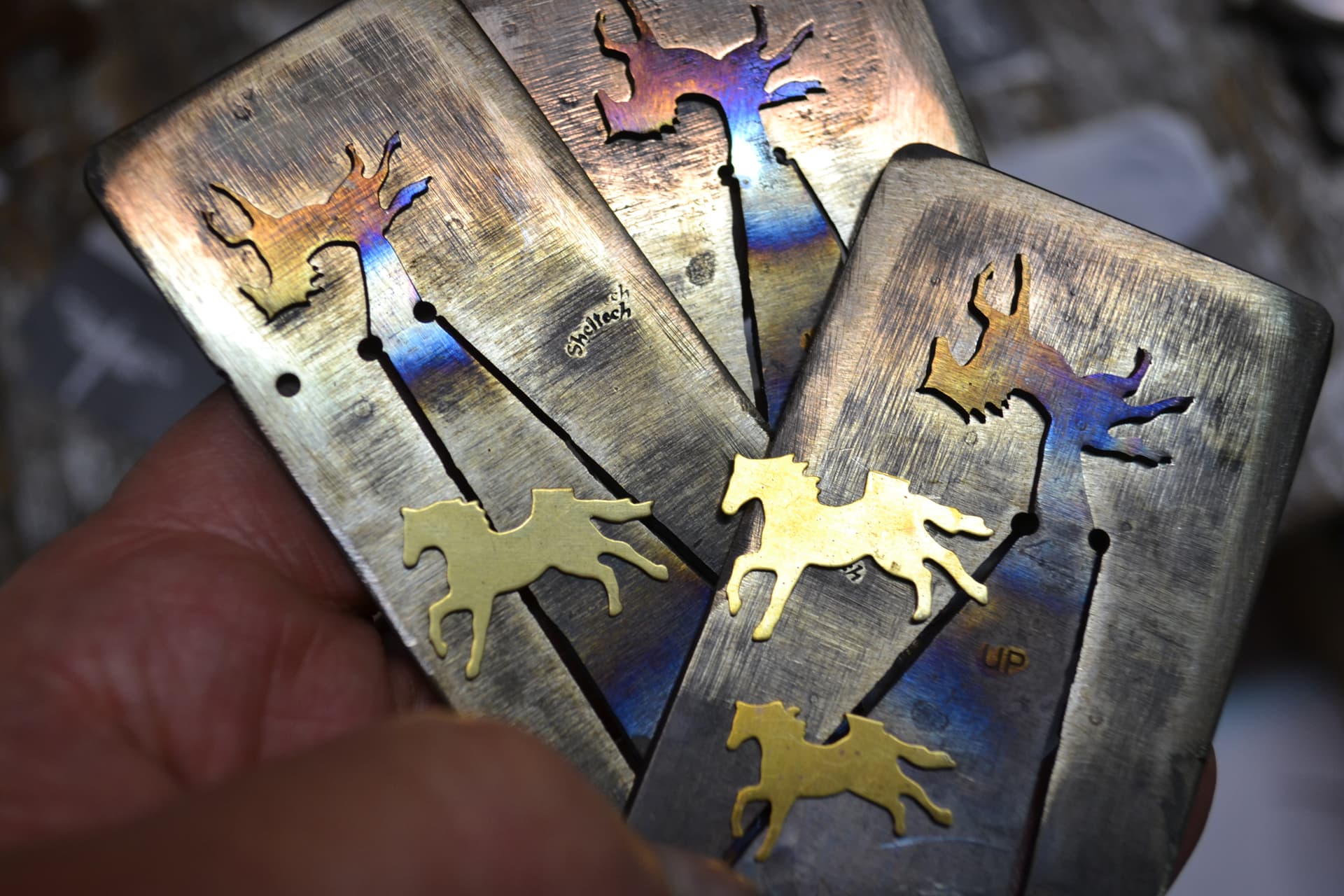
Let’s see what’s left in the camera’s card…”plain” dies only in this post .
No impression plates involved.
Let’s see what’s left in the camera’s card…”plain” dies only in this post .
No impression plates involved.
Looks like lots of work. I like the bezel strip and plan on cutting one. I am working on anything that doesn’t use up silver right now. Are the Colors in the horse hinge area from tempering? thanks…Rob
Amount of work is relative. Dies like horses can be nearly unbearable. I have minimized the anguish by using the hardest blades (all blades with ‘Platinum’ in the name, all discontinued) and a type of steel that is a little easier to saw than the 0-1 I used for 30 years, and is still through-hardenable.
(A couple years of trial and error ommitted here) That is 4130 alloy steel, and yes, the discoloration is from torch-annealing (tempering) extra at certain spots. First I prop the dies open with a thin metal shim and hit the base of the hinge. This “freezes” the hinge and design in a semi-open position, making them much easier to operate (push/hold open with one hand and load metal with the other). Next I hit the connection area of hinge and design, because that area flexes and is under a lot of stress when the die closes down, right before it pops (cuts).
Thanks, I bet that the sharp points are a challenge to keep sharp…Rob
I don’t understand what you mean here : “ I bet that the sharp points are a challenge to keep sharp”.
Maybe you mean sawing the die so that a design’s sharp points are sharp. That would make sense, so assuming that’s it, yes, it can be a challenge. It isn’t always practical from a sawing standpoint, because the smaller the blades get (for sharper points) the more frustratingly difficult it is to saw thick steel. I almost never go smaller than 4/0, and to get around points and try to keep them sharp, it can take as many as 40 or even 50 strokes on thick steel. Yep, that’s not a typo.
Then there’s the matter of how fragile super-sharp points are. Even on a hardened die points can deform under the pressure of cutting metal, so I don’t always saw points as sharp as I can. On a die like one of these horses it gets maddening pretty quickly, espcially when you have to fight the blades, as is often the case with 4/0 (but that’s a whole other can of worms). 
Dar
Dar…You answered my question. I have made dies with sharp points and they are both hard to saw and don’t stay sharp very long when I use them. I don’t temper my dies as they are often one and done, as in punch out 20 pieces and then they go into a drawer. The steel is also too soft to harden. My 76 year old hands can’t take a lot of sawing, so I like to do it once making a die rather than try to reproduce the same shape 20 times with a piercing saw. I get my 16 gauge steel from a local welding shop (I should look for a better source) and find 3/0 blades at 10 degrees to be a good combination for what little I do. I have been buying Super Pike blades and they seem to work as well as any. I think that they have a rounded back to make them a bit more manuverable. I also bought Jayne Redman’s rotational work system. While it is intended to do complicated small piercings, it helps me work on smaller dies and maneuver the tight spots a bit easier. It does take some setup time. The work that you do is fascinating to me in that it depends on the right combination of a few simple tools and a lot of experience using them. Many people just starting out making jewelry look for tool solutions to their problems when learning to use what you have is the real solution. Thanks and keep posting your work…Rob
Re: Old hands….After 55 years of metal smithing and over 60. years of guitar picking my hands are shot. I have done a few hacks to help. For my flex shaft I got some narrow foam tubing that is used for insulating interior water pipes. It happens to be just about the right diameter for a standard flex shaft. I used double sided tape to keep it from slipping. The larger softer hand piece is a great relief. For saw piercing I use my all time favorite Green Dragon saw frame. The Green Dragon Co. also makes tattoo hand pieces. My husband Tim and I worked in a tattoo shop for a couple of years. The endless hours of having a heavy metal, and vibrating tattoo hand piece can be really hard on one’s hand. Their saw frames are perfectly balanced and the hand piece is a larger softer handle. I also wrap white cloth surgical tape round the the shafts of my chasing tools so I don’t have to clench so hard. Then there are the light compression arthritis gloves with open finger tips. as well as weight lifters gloves.
Hands aren’t the only parts that get old. Getting up in the morning around our house is a slow motion event that gets better once the coffee is made and the cat fed. This has been a bad winter so far, even by Central NY standards. As a result, we are stuck inside other than to shovel and blow snow, make a quick trip to shop or the doctors and then come in and warm up. We are looking forward to seeing the sun, getting out side and working in the garden, riding our bikes and seeing our neighbors. Maybe we won’t feel so old then…Rob
Jo, go to a pharmacy and in the ace bandage section they have hand braces that are like fingerless gloves. They use velcro to secure it around the hand. It helped me very much after I smashed my had and other atrocities. They are light weight, not bulky, and non constrictive. That and doing a sink full of as hot of water as you can stand to wash dishes. The movements you do to wash the dishes, help to loosen up the muscles and force you to do exercises that will afterwards make your hand love you. Next this is for Don. Mother Nature has decided to vacation here in Orlando Florida. Her winter time frolics are out of control. She is drunk and needs to go back up north.
Aggie not liking 21 degrees in the Land of the Mouse.
Jo…I have played guitar and banjo since may 26th, 1988 with re-attached fingers on my left hand and a reconstructed right wrist. I have very little feeling in those fingers. They cramp very easily on a punch or a banjo neck. I have joked from stages over the years that ..”If this is so tiring why is it called playing.” I really appreciate that you know what it is like.
The hand injury has made it very difficult to hold stamps and punches in my left hand. I find it awfully hard to work very small. I can’t pick up tiny things with my left hand. All this has meant working with one off designs and special tools that fit my limitations and creating jewelry from there. If there is any luck in all this it was my 35 years working as a design and accessibility technician. I worked with people and their disabilities to create the means by which they could very often do simple tasks. So in a sense I was helping myself why being paid to help others.
I think we all have “Work Arounds” that allow us to do what we do. What seems obvious and simple to one may be enlightenment to another. i.e.: I can’t work at the bench without magnets and document clips holding the work.
What does all this have to do with pancake dies? Not much but the Old Hands and Guitars comment caught my attention.
Don
I have “arthritis” compression gloves that have the tips bare for grasping things. I also use weight lifters fingerless gloves. And finally a wrapt brace for my left thumb. I also do hand exercises for my annoying trigger finger. Getting old isn’t for sissies.
I don’t do much mind the getting old. It’s the feeling apart that gets me a little irritated.
I shall try the compression gloves.
Don
I’m glad you wrote those details because assistance is only …. a couple weeks away, given how infrequentyly I visit here (my Facebarf group ruined me) . I think for you getting some tool steel and hardening it. Technically, the entire process is heat treating, which consists of two basic stages. Quensching in oil from about 1500F to harden, then tempering or “drawing” at a lower temperature ( maybe 600-850F depending). This is easy to do with 0-1 flat stock. It’s harder to saw but worth it if you value not sawing dies over. You can also use thinner steel : 1/16” for 18 ga or thinner (16 ga. in a pinch), or 3/64” for 22 ga. or thinner (20 in a pinch).
Dar
Hi, I’m very much relating to all that. Guitar playing is very limited now, as I preserve my hands for work, but I still noodle. No more athletic playing though. Here are a few things that have helped me a lot. 30-Day Thumb Club - check out Michelle Coil’s youtube 7 Helpful Hand Exercises for Rheumatoid Arthritis: A Beginner Hand Workout . Castor oil and Magnesium oil wraps for sleeping (messy and smelly , but effective). Various supplements ….(do your own thing). One other thing I started using is BPC-157. It makes recovery from exercise much easier. Promotes angiogenesis and general healing. Possibly worth a look into.
Dar