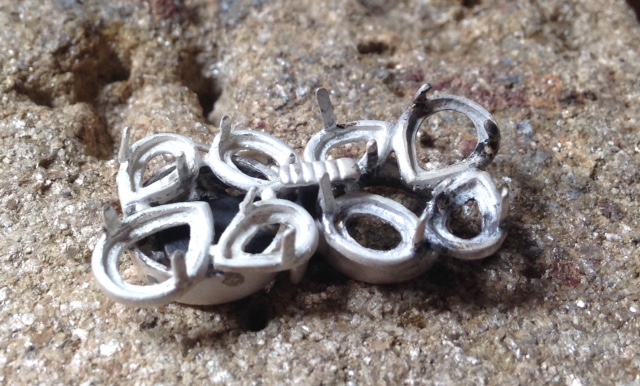
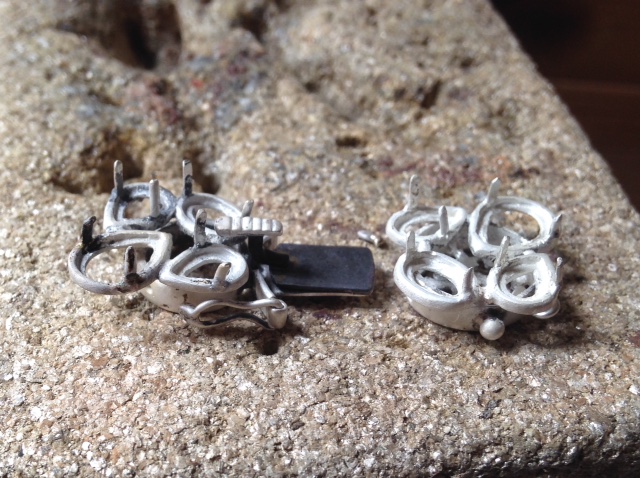
Kate, a couple points to note. First, paste solders are often the easier, lower melting solders. And they sometimes can seem to have fully flowed, when they have not actually done so. Try switching to sheet solders, using clipped paillons placed next to the tightly fitted seams. Try to use at least z medium flow solder. Hard is even better. The higher melting the solder, the stronger the joint.
Next, and this is important, design your piece so the claws of prongs are not being asked to bend right where they are soldered on. Usually, the bending point, and where the seat is cut in the prong (if you are cutting a seat) should be above the solder seam, not at the level of the solder seam. Unless you are using hard or IT solders, the seam will always be a bit weaker than the silver itself, so dont ask the seam to bend.
Then, you say the claws are hard after soldering? Why? You should be starting with annealed soft metal for the claws. In order to have them harder, you have to have only heated it to below annealing temps, and then cooled quite slowly. This isn’t actually easy to do, especially if using actual silver solder. Please make sure the solder you use an actual silver solder, an alloy if silver, copper, and zinc. Melting at temperatures above 1000F where your silver is near to glowing. Not some of the confusingly labeled silver-containing low melting solders that are primarily tin with a bit of silver. These are commonly used for repair at temperatures from 200 to 450 F, similar to electronics lead solders. They have little strength, and would never hold a prong in place. Sold with names like “TIX”, “Stay-brite”, and others. When you are using actual silver solders, let the metal cool until it is no longer glowing, and then quench in water. This assures that it won’t age harden from too slow cooling.
And finally, please be sure you have not accidentally used a metal other than silver. Accidentally soldering on prongs of “nickle silver”, or stainless steel binding wire, or similar, when the piece is sterling, will give you very hard prongs that just snap off… it would seem difficult to make this mistake, but its not. Prongs are small and the color difference might not be obvious… if you are not sure, use a little silver oxidizing solution, or liver of Sulphur, to blacken a tiny spot and be sure it reacts the same as other, known to be silver, stock does.
Hope that helps.
Peter Rowe