Ok, here goes. When I first started working with Argentium some years ago, I had never heard you were supposed to use separate tools, etc from those you used for regular Sterling at risk of contamination. I have never separated tools and have no idea what such contamination would look like or what problems it might cause! I sometimes, often, use Argentium and Sterling in the same piece!!!
What is the contaminant? Is it supposed to be the silver in sterling? Is it the copper in sterling? The idea that sterling can contaminate Aregntium makes no sense. I have used the same files and other tools on both alloys for many years with no problems at all.
I agree completely that this idea seems impossible. Maybe others on this thread can comment on this idea. Perhaps they refer not to Argentium and Sterling, but one of the other alloys mentioned?
The idea that a tool like a file used on Argentium is somehow going to then contaminate sterling is silly. There is likely little or no metal transfer and only 1% of that would be germanium. It is about as likely to happen as iron transferring from the file. And then you polish, removing whatever may have gotten transferred. It’s a storm in a teacup.
When Argentium first came out and some tried it expecting it to work just like any other metal they’ve used before, and found it didn’t work exactly the same, they seemed to do a Chicken Little over it, gave up without learning how to use the alloy, and a bad wrap was started. The ‘bad reputation’ seems to be continually repeated by people who have never even used Argentium, and I find that very frustrating.
Argentium can slump at soldering temperature
Argentium can melt if overheated
Argentium can tear if poked with a soldering pick at soldering temperature
Simple solutions, support the work, don’t overheat, don’t tweak solder when the Argentium is glowing. Easy. It isn’t diamond setting.
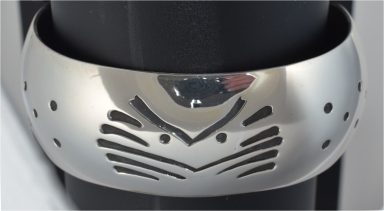
Here’s the other story about Argentium. (Please ignore camera reflection and someone’s fingers at the top)
I made the above overlay cuff by piercing a layer of Aregntium sheet, putting it on a backing layer of Argentium sheet, and then fusing the two with:
NO SOLDER
NO FIRE COAT
NO FIRESCALE
NO FIRE STAIN
and after about 15 years later the piece still has
NO TARNISH
What is not to like about that?
If a new user has some trouble with first attempts, please learn the material. And if you’ve never used Argentium, please stop spreading disinformation.
Thanks, Neil. I also love Argentium for all the pluses you list, plus the fact that I can fuse layer upon layer, no flux and create such interesting textures that I doubt would be possible with regular Sterling. The way it fuses is magic, nothing short.
I would still be very curious to know from others here if there was once a concern about contamination, because to me it seems rather odd.
Not sure where the idea about needing separate tools comes from. There is nothing in Argentium or standard sterling that will contaminate either alloy in either direction.
I think there are a couple of reasons for the “bad rap” about Argentium. First, the original alloy was, without a doubt, softer than standard sterling. Second, the original team who were promoting it insisted that the original alloy was, hands down, better in every way than standard sterling and created a large amount of misinformation about Argentium’s supposed superiority, despite testing that did not support that assertion. Much of the misinformation stemmed from believing and repeating the manufacturer’s marketing information rather than independent testing. The ownership/manufacturing of Argentium has changed hands once or twice since then. Research and testing of more recent alloys have definitely improved their performance.
The newer Argentium alloy 940S is better and, in many cases, equals standard sterling in terms of hardness. Its fusing performance is also quite attractive. It still has a bit of a hot-short issue, but as you note, supporting it while hot and not moving it at temperature are all you need to do to avoid it.
At this point, Argentium 940S is very competitive with standard sterling in many cases and, given its fire-stain resistance and low tarnish, it is quite attractive. Still, it has higher costs, a narrower range of sizes and shapes, and supply issues. One of the main reasons for supply issues is that only one or two companies have the rights to manufacture it in the US, whereas anyone can make standard sterling.
I am not a metallurgist so I can’t answer this question. Those of you who work in both Sterling and Argentium, and who also recycle your scrap into new useful shapes, may have mingled Sterling and Argentium scrap in the process. Has the metal that results been a problem to work with?..Rob
Rob, speaking for myself I keep the two alloys separate because when I melt down Argentium scrap for re-use I want it to be ‘plumb’.
For the most part any standard sterling I use these days is only in the form of findings & such where I cannot buy Argentium or Continuum. My stone setting is …a work in progress , and harder Continuum helps keep me from over-cutting seats, especially compared to the Argentium mountings I still have.
Neil…If I worked more in Argentium, or another alloy like it, I would keep the scrap separate from my sterling scrap. I am pretty sure that, when ever I even up my Argentium ear wires, small pieces get comingled with my Sterling scrap. I have not noticed any difference in behavior that I can attribute to the stray Argentium scrap…Rob
 , and harder Continuum helps keep me from over-cutting seats, especially compared to the Argentium mountings I still have.