Hi Brennan,
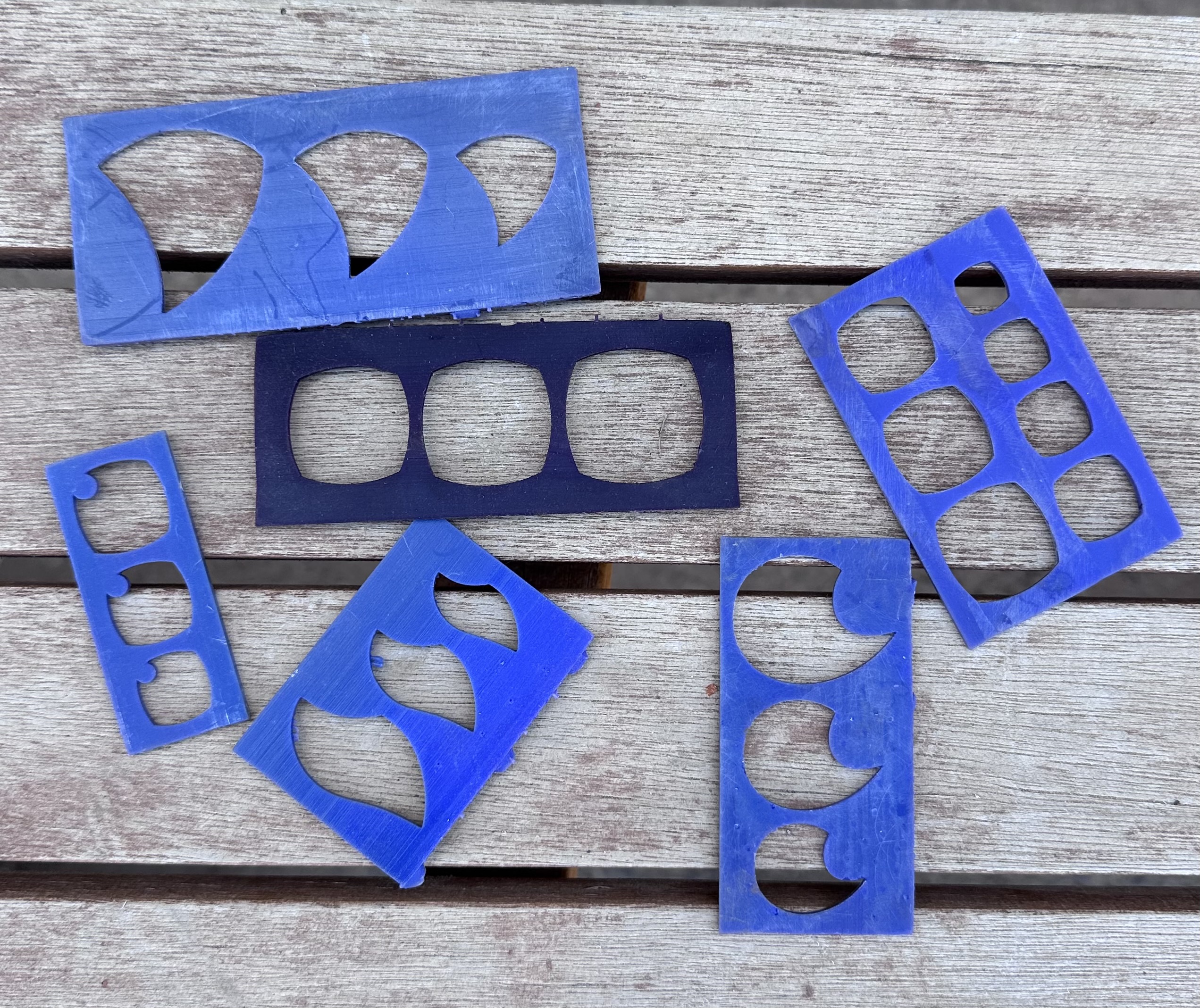
Here are a few lapidary templates that I’ve printed using an FDM printer. It works well for this but other types of material and a different print format like nylon or carbon fiber could be very durable.
With 3d printing you can manufacture just about anything you can dream up.
if i had one, i would make tool holders! (i was looking for holders for my grs qc graver collets…ended up ordering wood ones from a far away country… thought the 1/4” holes (for drill bits) would fit but the were a bit too tight…i had to open n up a bit…was a drag!) needed metric drills…
and maybe a set of vise jaws that would hold a tapered mandrel firmly when whacking down on a horizontal mandrel…or tapping down on a vertical mandrel (for both ring and bezel mandrels…
and maybe something that would clamp a mandrel on a downward angle…(wing nuts come to mind!…)…above the bench top edge…and still screw into a dovetail mount…
holding mandrels for whacking would be on the top 5 list…
and flexshaft handpiece holder(s) to attach to the bench edge…or at least restrain the hanging flexshaft cord…
i wonder if those lapudary templates would work in a press?
Send me a message if you ever want to collaborate and I’ll model/design with you and then print and send to you. We can share with the community the files.
I’ve wondered about making dies for a press . There isn’t any reason that couldn’t be done, I made quite a few for a press based on Susan Kingsley’s and was casting them in bronze. All were hand carved and rubber molded etc
I still have the dies and once in a while run across them . Really sky’s the limit as to what can be done.
Printing technology is just another tool in our bench
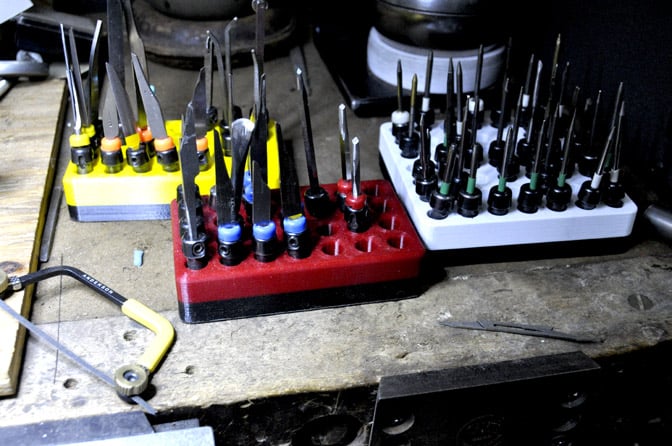
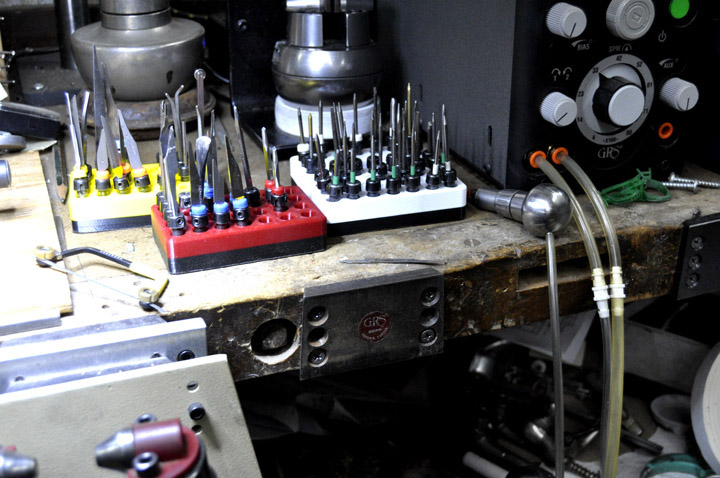
I 3D FDM printed some holders for my GRS tools. Had the official GRS round holder for years but never liked it. Made the holes a little loose so the tools drop in easily. Could also be printed resin ABS on an inexpensive Anycubic or Elegoo printer.
Dave Erikjewelers.com
That is the “Anderson Miniature Sawframe” I designed it a number of years ago. (posted about it in Orchid but didn’t get much response) I supply it to a number of tool distributers, like Stuller, Rio , Otto Frei etc.The one in the picture has a strip of abrasive for cleanup. I first made it to touch up delicate setting, if you need a little more space under a stone or prong to level it or make the prong fit better. Usually use an 8/0 blade. Just for delicate work. 90% of the time I use a regular sawframe.
The red on the collet expander on the engraving ball is another FDM print.
I use a line-loc arm to hold my iPhone for watching videos and recording at the bench but I’m curious if I can 3D print more links so that’s what’s on the printer right now.
Dies for a press? I use my 3D printer to make texture plates for my rolling mill, so I don’t see any reason one couldn’t make press plates as well.
Those with fine texture don’t last very long. The fine edges tend to get squashed after a dozen or so passes and the pattern loses detail. But when they’re no longer crisp, I just throw them out and print another. By comparison, plates having less fine detail last a lot longer.
I really like how inexpensive they are to produce and the versatility of being able to design texture patterns limited only by one’s imagination…
Not much for the jewelry works but I recently designed, printed and programmed a duck food feeder to automate my duck feeding duties. It’s got a little auger and a dc geared motor and a esp32 that I can access via wifi. Pretty cool!
My most recent project uses a Raspberry Pi with a camera module to create a spy cam to keep tabs on a family of squirrels in my back yard living in a nesting box I built for them. The project is battery powered and uses a solar panel to keep the battery charged. It streams video via WiFi to a computer in the house that stores the last eight hours of video so I can scroll back and see what the family was up to while I’m away. The project enclosure and the solar panel mount are 3D printed. I considered using an ESP-32 module to add pan, tilt and zoom control to the camera, but that turned out to be unnecessary overkill. A fixed focus camera mounted inside the squirrel nesting box was more than sufficient.
On the topic of 3D printed jewelry tools, I printed a rotary holder to keep jeweler’s saw blades organized. I also shamelessly stole an idea advertised on eBay for a two piece vise clamp for my Foredom H-30 handpiece. The two halves go over the jaws of my bench vise and the handpiece is clamped in place by pressure from the vise jaws. My version has a tiny improvement that makes a big difference in convenience. I added cylindrical recesses sized to hold strong neodymium magnets to secure the halves of the clamp to the metal jaws of my vise. The magnets are epoxied into these recesses. This modification eliminates the need for a third hand to hold everything in place while tightening the vise jaws.
I’m currently toying with the idea of making a jewelry filigree crimping tool. I had been considering buying the tool linked below, but it does not have as much flexibility as I want in terms of a range of tooth sizes and patterns. I’m thinking of designing my own version with replaceable gears, or perhaps multiple tools in different sizes. Haven’t decided yet, suggestions welcome…
regarding a crimping tool…what about if the crank was on the side…and there was a single horizontal rod…with…say…3-5 crimper wheels on it that were all the same diameter…but with different tooth per inch spacing…the gear at each end matching the crimper wheel diameter
if you need a different diameter crimper wheel, then you just need the matching diameter end gears…they would fit the original rod…
You’re hired! You’re now my chief engineering design consultant! I like the way you think Do you and your husband frequently design your own tools?
The single drive shaft makes it possible to use a single hand crank. Now it’s time to figure out the best way to mount the matching idler gears. They will require idler shafts mounted at different distances from the driven shaft according to their diameter. This distance needs to be tuneable to allow for adjustment to accommodate different thicknesses of filigree wire.
Do you create much filigree for your jewelry? Do you have a favorite style? If so, what do you like most about it?
I’m just getting started on my filigree journey. Thus far I really like Russian style best. I like the airy feel it has…
I purchased the online streaming version of Victoria Lansford’s Russian Filigree…I shoulda bought the DVD…i think i bought streaming by mistake…?…i forgot…
she also has an online course
I also have her Eastern Repousse DVD and Eastern Repousse Tool set…i have other sets, but i personally feel hers are the best…it is amazing how much you can move metal…i made a tiered heart…like a tiered wedding cake…from a flat piece of metal, to like 1” tall…!
She also sells filigree wire (filler, frame), powdered filigree solder…
Victoria Lansford is amazingly talented…check out the rest of her website to see her work too
 Do you and your husband frequently design your own tools?